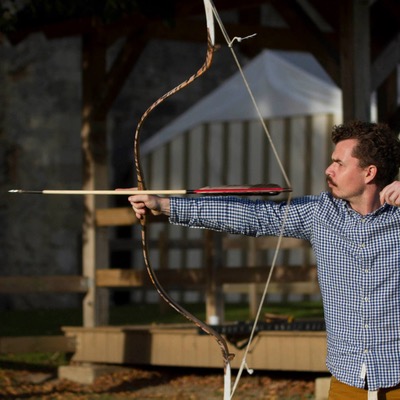
Maximum practical draw weights for horseback archery?

This is where we discuss techniques used in Asian archery.
Hyarmendacil
Posts: 118
Joined: Sun Jun 01, 2008 9:12 am
Location: Indonesia

Post by Hyarmendacil » Thu Jun 26, 2008 11:10 am

Bede wrote:I don't agree that the major effective use of arrows is in their fatal effect. Wounding can have more damaging consequences because of the incapacity of the victim, the resources used to get them out of the battle line if they are important enough and the disruption to the battle line.

Taking out a commander as with Harold at Senlac Hill is a rare event. Usually archery caused disruption in enemy lines. In the case of the Parthians, they used to concentrate and slow down their enemies.
Very true. This is an important point that people often miss when discussing horse archers, especially heavy horse archers; in many cases the archery itself was not expected to be the be-all and end-all of their horse archery tactics, being used instead as a prelude to a charge and/or hand-to-hand combat.

Alex S. wrote:Once we have a chosen culture, it would be easier to go into further research about their military system and with a set date, we can determine what armour they were up against etc etc...
And the tactical paradigm they expected to use! We must never forget that an archer that expected to use his bow in sustained skirmishing or massed archery duels would have treated his archery equipment and techniques differently than one who saw the bow primarily as a device for weakening the enemy prior to a charge--let alone an archer who was expected to be able to do both (like early Byzantine horse-archers).
User avatar
Bede
Posts: 2360
Joined: Mon Mar 14, 2005 11:57 am
Location: Sydney, Australia

Post by Bede » Fri Jun 27, 2008 6:37 am

Jack,
I did have one Javanese folded iron and nickel iron arrowhead tested. It's hardness was equivalent to a table knife. However, armour was not common in Indonesia so it would performed effectively.
Bede
robno
Posts: 43
Joined: Mon Jul 07, 2008 12:24 am
Location: ?sterg?tland, Sweden

Post by robno » Fri Aug 01, 2008 12:18 am

I'd say that a fundamental assumption should be made when it comes to tests of arrows vs. armour for different periods, countries, dynasties, whathaveyou:
As with any "arms-race" they will constantly try to adapt to fit what resistance they are facing, both equipment-wise and tactics-wise.

This does not gainsay anything stated sofar here, really, but it is something I've found lacking in those tests I've either seen or heard of.

Thus, to chime in with a few other variables when it comes to actual warfare:
1) For shots at a distance, the question of design of helmets (thickness, where there are openings, etc) is highly important. A sharp stick hitting your eye at "only" 80 mph would penetrate quite well, to say the least. Likewise, if the helmet is too thin then something worse than migraine may well occur.
2) In most armourdesigns, protection around the head is mainly against ground-level attacks: There is always some kind of gap by the throat or the head is impossible to move. Thus, an additional area to hit specifically from a distance.
3) Wear and tear: The discussion here has mentioned questions of how different effects you get from tightly or loosely fitted armour. Add, when discussing hail of arrows, what would happen when many arrows hit the same area (say 5-10 arrows hitting the same 10-20 square inches)
4) Finally, closely related to the former: Before the most modern days there has never been an army where absolutely eveyone in a prolonged war with several battles had the most top-notch, squeaky-clean and brand new armour all the time. That little beginning of a crack from last battle may give way this time around.

Edit, as I forgot this:
Going back to original question of this topic:
There really is strong reason to believe that any draw weight would work from horseback, assuming you are a good horseman with a horse who knows to respond well. It's only a question of adapting your tactics. Heavy bow will be difficult to use to squeeze off many and fast shots, regardless of how good a technique you have, but fits perfectly for an assault head on.
It is possible - but this is only guessing - that a Parthian shot will be quite difficult with a heavy bow due to limitation of what muscles you can use, but both facing forward and to the side should not be any problem with any bow you can shoot while walking or running on the ground (thus also with a limitation on what muscles you can use since you can't use your legs as freely for leaning back or forward for help in drawing in the manner often seen by modern warbow-shooters)
User avatar
Orda Khan
Posts: 433
Joined: Thu Sep 28, 2006 11:45 am
Location: Wales

Post by Orda Khan » Fri Aug 01, 2008 3:59 pm

Agreed. I've argued many of these points on numerous occasions.That an arrow fails to penetrate in modern tests proves nothing as far as I'm concerned, not every soldier could afford good armour, let alone a full set of the latest, most well made.
We have few facts of the weight of these bows, but I think it is safe to say the lightweight bows used by modern horsearchers are a result of the competitions; ie more shots, more points.
User avatar
Peter Dekker
Site Admin
Posts: 171
Joined: Sun Oct 01, 2006 11:21 pm
Location: the Netherlands
Contact:

Post by Peter Dekker » Sat Aug 02, 2008 10:42 am

Orda Khan wrote:Agreed. I've argued many of these points on numerous occasions.That an arrow fails to penetrate in modern tests proves nothing as far as I'm concerned, not every soldier could afford good armour, let alone a full set of the latest, most well made.
One also frequently finds in texts that they shot the largest target on the battlefield first. Chinese poet Dufu: "Before you shoot the rider, shoot the horse." In the battle of Liegnitz the Mongols also supposedly weakened the knights and their horses with arrows before the heavy cavalry came in.

It is already pointed out that by far not all warriors would have the latest and best armor, but even fewer would be equipped with full horse armor. And if they were, their horses would tire out much sooner than that of the light cavalry. All trade-offs. And when their horses weakened, and their response time was affected, heavy cavalry could come in with armor piercing spears. I've got an 18th cent. armor piercing "mao" spear from China, I don't think there are many armors that could hold off a full speed attack with one of those. It has a diamond cross-section, 19 mm thick, and with a separate hard steel insert at the very tip.

And even if arrows wouldn't penetrate armor, we should not exclude blunt force trauma. Lamellar armor is very good at stopping arrows in a clinical test. But how does it feel to get hit by a heavy arrow, with the plate being pushed into your body? A sword doesn't cut lamellar armor either but a heavy strike from a horse against someone in this armor could very well break bones without actually penetrating.
Orda Khan wrote:We have few facts of the weight of these bows, but I think it is safe to say the lightweight bows used by modern horsearchers are a result of the competitions; ie more shots, more points.
My thoughts exactly. What also plays a major part is that most of us are hobbyists with a different focus. Those guys in the old days were professional soldiers whose lives depended on it. They had more reason to try harder.

-Peter

Hyarmendacil
Posts: 118
Joined: Sun Jun 01, 2008 9:12 am
Location: Indonesia

Post by Hyarmendacil » Fri Sep 05, 2008 3:14 am

All right, all right, now I'm fairly convinced that the heaviest bows in the arsenal can be used on horseback. I still believe they'd be a sub-optimal choice compared to medium-weight bows, though....
User avatar
Bede
Posts: 2360
Joined: Mon Mar 14, 2005 11:57 am
Location: Sydney, Australia

Post by Bede » Tue Sep 09, 2008 2:52 pm

One thing that a heavy bow restricts you from is the total number of shots. You get tired quicker. Ammianus Marcellinus said that the Roman bows were stiffer than the Persian bows, but the Persians could shoot a lot more arrows.
Bede
Hyarmendacil
Posts: 118
Joined: Sun Jun 01, 2008 9:12 am
Location: Indonesia

Post by Hyarmendacil » Fri Sep 12, 2008 2:55 pm

Procopius says that too--here's a quote from H.B. Dewing's translation of his history of the Romano-Persian (or Byzantine-Persian) wars during the reign of Justinian:
Straightway both sides began the fight, and the battle was exceedingly fierce. For the arrows, shot from either side in very great numbers, caused great loss of life in both armies, while some placed themselves in the interval between the armies and made a display of valorous deeds against each other, and especially among the Persians they were falling by the arrows in great numbers. For while their missiles were incomparably more frequent, since the Persians are almost all bowmen and they learn to make their shots much more rapidly than any other men, still the bows which sent the arrows were weak and not very tightly strung, so that their missiles, hitting a corselet, perhaps, or helmet or shield of a Roman warrior, were broken off and had no power to hurt the man who was hit. The Roman bowmen are always slower indeed, but inasmuch as their bows are extremely stiff and very tightly strung, and one might add that they are handled by stronger men, they easily slay much greater numbers of those they hit than do the Persians, for no armour proves an obstacle to the force of their arrows.
User avatar
jiao
Posts: 663
Joined: Fri May 06, 2005 1:24 pm
Location: china
Contact:

Post by jiao » Sat Sep 13, 2008 3:44 pm

the specialties case in china?

qin and han dynastic cross bow on horseback? so it is crossbow horseback archer? the crossbow is natural enemy of horseback archer?

or the north china nomad has no heavy or good armor so a light bow like korean bow enough use for a warbow?
Last edited by jiao on Sat Sep 13, 2008 5:18 pm, edited 2 times in total.
User avatar
Peter Dekker
Site Admin
Posts: 171
Joined: Sun Oct 01, 2006 11:21 pm
Location: the Netherlands
Contact:

Post by Peter Dekker » Mon Sep 15, 2008 11:07 pm

At least for the Chinese, I am beginning to think that there may not be a definitive answer to this. Judging from garrison inspections and sources of scholars from the era that touch on the subject, there was quite a diversity in the bows used by the Chinese military from at least the late Ming and throughout the Qing.

A nice window into the late Ming is Song Yingxing's Tiangong Kaiwu where he states that there were various classes of archers in the military:
"Tiger strength": More than 120 catties
Strong bowman: About 120 catties
Average bowman: Between 96-108 catties
Weak bowman: About 60 catties

(There seems to be a gap between the average and the weak bowman)

He explains that all bows are strong enough to be used effectively but there was a difference in the deployment of the troops. In the battlefield the stronger archers were need to pierce a man's [armored] chests and go through thin wooden shields. The weak archers were esteemed for their marksmanship and "...thus conquering through skill instead of main force"*

It is probably comparable to the wealth of different calibers used in modern warfare, all with different levels of accuracy and rates of fire. It would be similarly hard to determine what the "best" modern gun is, because a combination of different arms is often more effective. For example, the sniper can be a valuable asset to a special forces squad, but he probably wouldn't want to do without men backing him up with more rapid firing guns when situations ask for it.

*(See: Song, Yingxing, translated with preface by E-Tu Zen Sun and Shiou-Chuan Sun (1966). T'ien-Kung K'ai-Wu: Chinese Technology in the Seventeenth Century. University Park: Pennsylvania State University Press).

-Peter
User avatar
Orda Khan
Posts: 433
Joined: Thu Sep 28, 2006 11:45 am
Location: Wales

Post by Orda Khan » Tue Sep 16, 2008 4:05 pm

Yet we also have reports of arms being pinned to shields at Carrhae; bows of the Huns being feared etc. We can see an element of bias in that quote also, 'used by stronger men.'
Hyarmendacil
Posts: 118
Joined: Sun Jun 01, 2008 9:12 am
Location: Indonesia

Post by Hyarmendacil » Thu Sep 18, 2008 9:29 am

Maybe the difference could have had something to do with the temporal dimension. The Parthian archers at Carrhae fought some three or four hundred years before the Sassanids (a different dynasty with an axe to grind against the old Parthian one!) that Ammianus faced and fully half a millenium before the later Sassanids of Procopius's accounts. So I think it's quite possible that the Persian standards of bow strength and/or arrow weight had fallen in the meantime or that Roman (and maybe everybody else's) armor had developed to become more effective against archery in that timespan.

Note also that the Huns and Persians had two different (though related) horse archery cultures. The Hunnic tradition was the one adopted by the Romans in the 5th century A.D. and thus what we see in Procopius's accounts may have been a comparison between Hunnic (in Roman hands) and Persian styles!
Hyarmendacil
Posts: 118
Joined: Sun Jun 01, 2008 9:12 am
Location: Indonesia

Post by Hyarmendacil » Thu Sep 25, 2008 1:14 pm

I've been rereading some old downloads, and one of the things I stumbled across was the ATARN translation of the archery section in Qi Jiguang's manual. When I first downloaded and read it I hadn't begun to seriously study Eastern styles of archery so some of the points went over my head. Now, though, one of the points made in (translated) text caught my attention:
In horseback archery, always release when you are [at least] ninety per cent of full draw: Never forget! it is difficult to hit when the bow is just seventy or eighty per cent drawn.
It seems to advise mounted archers to choose a length of draw within a fairly narrow range that's not exactly full draw but definitely long enough to extract most of the useful energy in a bow--as corroborated by another passage:
When you . . . keep your potential energy high and restrain it on a short leash, then every shot will strike home and no-one will be able to get away from you. To achieve this, you need to keep all of your actions short of the maximum: draw but do not pull the bow to the full extent of your strength; and make sure every shot counts.
This one also has mentions the "reserve energy" idea. I haven't read Li Chengfen's work but this passage from Qi Jiguang seems to agree with him. The two were more-or-less contemporary with each other, weren't they?
Alan Flashing
Posts: 181
Joined: Fri Jul 18, 2008 10:36 pm
Location: Oakland Oregon,USA
Contact:

mounted archery draw weight

Post by Alan Flashing » Wed Mar 18, 2009 11:16 pm

I have read through the pages of this thread and have not seemed to be able to find an agreed upon practical maximum draw weight for the mounted archer.
I would be very interested what they actually were, 60-70 # 80-90# or above?
Regards,
Alan Flashing
User avatar
Bede
Posts: 2360
Joined: Mon Mar 14, 2005 11:57 am
Location: Sydney, Australia

Post by Bede » Thu Mar 19, 2009 12:52 am

Alan,
The problem is that the question is unanswerable. The maximum draw weight is the one the strongest horse archer with access to a strong bow used. He's dead and he didn't write anything down. Also one culture may have favoured strong bows while another favoured fast shooting.

What we are all discussing is the average maximum draw weight that we can substantiate from archaeology (did they have bows that could be made strong), literature (what did they expect people to use at the time) and modern experience (what people we know of have tried out). This will not be resolved easily either. However, we have identified some issues;
  • The bows used varied by period and culture.
    The techniques of warfare varied.
    The reporting of bow strength had a nationalistic element.
    Through a period of time, different groups may have improved their bows or remained static, while their neighbours did the opposite.
    The effectiveness of bows is not just related to their draw weight so, while it is an interesting measurement, it is not the only relevant one.
Personally, I have never seen any difference made by the bow weight whether drawing on foot or on horseback with stirrups. However, I have not shot much from bareback and I found it was easier with a weaker bow, but that could have been inexperience.
Bede
Post Reply