

Jack is right about the relationship of the Buryat bows. There were Buryats in the Qing armies and they were strongly also influenced by their close proximity to the Mongols proper. The Buriat bow, at least those lacking kasans as Jack mentioned, also show influence from Siberian and other Northern wood-laminated bows.
String bridges in the form of small triangular plates with rounded corners and sunken centre are common in the area north of the Black Sea as far east as Central Asia. Bows were collected by Moser in the nineteenth century and there are earlier ones in several collections. This covers bows from the Crimea, Bashkirs, Circassians, and several other groups like the Eastern Turkmen. The earliest dated bows I have seen with this feature are Iranian bows from the 1500s. However, as I have pointed out elsewhere on this site, there is a fair amount of evidence in paintings that they were introduced at the time of the Mongol invasion. I think that these smaller string bridges were more to protect the belly of the bow from the impact of the string knots than prevent the bow from unstringing itself. The fact that they gave extra insurance from unstringing accidentally was probably a benefit that wasn't anticipated at first. At least one painting suggests they may have been design to move the string away from the belly of the kasan, but it is hard to tell from a painting.
The drawing I was referring to was a Kalmyk archer. The Kalmyks are those Torghuts who chose to remain in Russia when the majority decided to return to Dzungaria. The name, Kalmyk, is from the Turkic verb meaning to "leave behind". Torghuts were Oirat or Western Mongols.
Help me identify an asiatic bow
-
mongolianarcher
- Posts: 299
- Joined: Thu Jan 22, 2009 12:51 am
- Location: Florida
-
bowyer tom
- Posts: 17
- Joined: Sat Jan 27, 2007 10:45 am
- Location: sweden
correction
I have edited this message, since I had the facts all mixed up about C.G Wrangel and gen. Bielke. I do appologize for this. Carl Gustaf Wrangel (1613-1676) had Skokloster castle built. Wrangel was fieldmarshal and fought under the king Karl X Gustaf. In receiving news about C.G Wrangels death in june 1676, the workers employed on Skokloster Castle just put their tools down and walked away, fearing not to be payed. In this way the castle has stood, with halls unfinished and tools from 1676 still on the old workbenches. Nils Bielke (1644-1716) was General Liutanent, ambassador in france 1679-82, guvernor general in Pommern, Germany 1687 and fieldmarshal 1690. It was in his role as Guvernor General and envoy he found himself fighting the Ottomans at the side of the western allies wit a smaller part of a swedish cavallry-regiment (The Household-cavalry, the Kings best...)Bielke was truly interested and fascinated by beutiful objects. The weapons and items he and his swedish soldier looted after the battle of Mohacs, 1687, was donated to C.G Wrangel and Skokloster castle shortly after Bilekes homecomming. Apart from the archeryrelated items, there are also saddles, sabres, and other war-related items i Skoklosters collections, comming from the second battle of Mohacs, 1687. Below are some of the remaining photos I took when visiting the bows. I had a poor camera and I was short of time. I?ll do better next time...


Last edited by bowyer tom on Wed Aug 12, 2009 8:02 am, edited 1 time in total.
-
Daniel
- Posts: 99
- Joined: Fri Nov 07, 2008 9:19 pm
- Location: Poland/Ireland
-
jack farrell
- Posts: 1864
- Joined: Sun Mar 13, 2005 3:40 am
- Location: Texas
Tom; You did good. This is the reason I love ATARN. Where else can one find these pictures?
According to google, Bielke fought in the second battle of Mohacs, in Hungary, defeating the Ottoman army mostly made up of Mamluks and Balkans troops and about 800 Ottomans in 1687. This would be the origin of the weapons you photographed. Bielke died in 1716
The similarity to the bow I photographed in Samarkand is amazing. These are very strong bows.
Apparently the Skokolster castle was built by Wrangel, am not sure Bielke ever lived there as all work stopped at Wrangel's death before the battle of Mohocs. Many items were donated to the castle, including, apparently, the Turkish bow collection of Bielke. -j-
-
bowyer tom
- Posts: 17
- Joined: Sat Jan 27, 2007 10:45 am
- Location: sweden
Of course. I stand corrected, and I can only say that I got things mixed up. Of course Wrangel built and Bilke donated. Bielke fought, with a small Swedish contingent, together with the western allies at the battle of Mohacs. http://en.wikipedia.org/wiki/Battle_of_ ... 1cs_(1687)
As I understand Nils Bielke was a liassons officer in Vienna, Austria at the time. Still, Bilke was surely very interested in beautiful things... Together with the bows, there are two big chests containing arrows, also captured at Mohacs. I also understand that they separated the bows from the arrows somewhere in the mid 1700?s. The reason for this, the curator of the museum, mr Nils Kyhlsberg told me, was that adventorous visitors shot the bows at the ceiling. Apparantly the ceiling is littered with arrowheads, portrouding in the attic-side, making it very difficult to walk there... Also, apparently, the bows, or some of them, was still strung at the time. Note that one of the bows has been fixed with tendons after breaking. This must have been done in the field, prior to the battle. One of the bows also show signs of being broken at the sayah when someone tried to string it backwards... After the battle i presume.....
I do appologize to all for my mixing up facts. I really do know better, but I was not humble enough to check facts before i Wrote... Sorry...
I had the chance to take a fast look, or a glance more, on the arrows. I?m really interested in them, because I?d like to figure out how many people, or artisans, were involved in the line of making a battlearrow, and how standardised they were.
It would also be interesting to compare these arrows with the replica medieval ash-shafts I make for my bows. Comparing weight, fletching, arrowheads, everything... Perhaps I can return to skokloster this fall. I?ll bring a better camera then...
Here?s a link to Castle Skoklosters official site:http://sko.lsh.se/default.asp?id=4620
Last edited by bowyer tom on Wed Aug 12, 2009 8:27 am, edited 1 time in total.
-
bowyer tom
- Posts: 17
- Joined: Sat Jan 27, 2007 10:45 am
- Location: sweden
additional photos
Thank You Jack.... Thank You... Daniel, I found the one photo i took of a small bundle of arrows. They seemed to be very uniform in presence, with the turkish form of fletching, with very long, low feathers. Some tips were broke of, wich lead me to assume that the tips are temepered. I will be back in this matter, though...
 The one photo I have of the Mohacs arrows
 A Turkish saddle made in silver...Warprize, Mohacs 1687
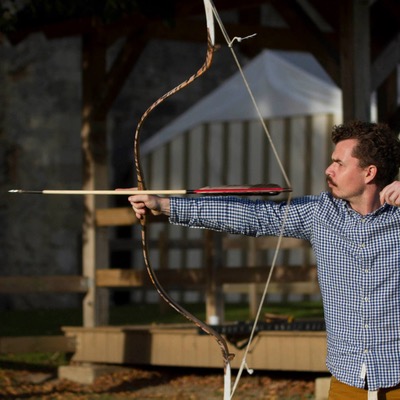
 And here I am, shooting at a viking fair this summer
 The one photo I have of the Mohacs arrows
 A Turkish saddle made in silver...Warprize, Mohacs 1687
 And here I am, shooting at a viking fair this summer
-
Daniel
- Posts: 99
- Joined: Fri Nov 07, 2008 9:19 pm
- Location: Poland/Ireland
Thank you Tom,
You wrote:
"I?m really interested in them, because I?d like to figure out how many people, or artisans, were involved in the line of making a battlearrow, and how standardised they were. It would also be interesting to compare these arrows with the replica medieval ash-shafts (...) Comparing weight, fletching, arrowheads, everything... "
This is exactly what I'm trying to find out. Looking forward to see more pictures of arrows from the museum
Regards
-
jack farrell
- Posts: 1864
- Joined: Sun Mar 13, 2005 3:40 am
- Location: Texas
Tom; Nothing to apologize for. i am just a stickler for provinience. This makes everything more meaningful. Provinience is everything!
Not only were these bows shot after the battle, they were worked on. Several have a cord wrapped around problem areas but the 9th from the bottom has a leather grip added over fade wrappings of this cord.
It also appears that someone has done a crude beginning repair to the siyah of the blue bow. Broken nock, two broken limbs and other breaks look suspiciously like post military repairs.
How about the bow with the three horn slats on the belly? Several have the setback grip like the Hazorasp bow from Samarkand. Several have very wide limbs. One has that so called Tatar look.
Even the arrows are not what I have seen elsewhere.
Maybe the use of Mamluks and Balkins troops speaks to the wide variety of material. -j-
-
jack farrell
- Posts: 1864
- Joined: Sun Mar 13, 2005 3:40 am
- Location: Texas
-
Dusan
- Posts: 990
- Joined: Sat Jun 30, 2007 6:29 pm
- Location: Slovakia

-
bowyer tom
- Posts: 17
- Joined: Sat Jan 27, 2007 10:45 am
- Location: sweden
Thanks a lot for the kind remarks. It makes all trobles well worth while. I have relayed the link of this discussion to the curator of the museum, whom is in charge of these bows. I hope this will add to an increased understanding of the value of these bows. I plan to be back at Skokloster as soon as I have a possibility. As I understand, the origin of the questioned bow has been answered, but there are some questions about the other bows. This can be explained by the fact that a lot of different asiatic cultures and subcultures were engaged by the Ottoman Army. The asiatic composit bow has a common origin and has been spread through out Asia over time. Is that, somewhat, right on target?
The next issue I will bring to question is the somewhat troublesome fact that there has been parts of asiatic archery equippement dug out in a Swedish viking site. These parts are questioned, but they origin from 800-900 AD. The site is the Swedish town of Birka in lake Malaren.
http://www.raa.se/cms/extern/en/places_ ... arden.html
But that would be a different topic
-
Peter Dekker
- Site Admin
- Posts: 171
- Joined: Sun Oct 01, 2006 11:21 pm
- Location: the Netherlands
- Contact:
I agree with Jack, it is really good to have all these good pictures turn up at this forum.
It has been a while since I last checked this thread and a lot has happened since.
What I would like to add is that I still maintain that this bow is very likely a late seventeenth-century Qing bow with no foreign influences as far as I can tell. Very few of these bows have survived to today, the vast majority being in the Palace Museum Beijing.
Especially notable is the rather natural look of it with no Chinese luck symbols anywhere on the bow, these only appeared in the mid. Qianlong reign. Especially the way the ears are done, with the birch bark covering all of it, is a tell-tale sign of an early to mid. Qing bow. I think what we are looking at is a bow as likely carried by officers in the Kangxi period, although the design remained much the same up until the late Qianlong era. It is surprising that the bow travelled so far, but then again, Qianlong had a Crimean tatar bow and Kangxi owned a Dutch sword so why not.
For clarity, I will sum up all the points that these early bows have in common:
1. Birch-bark covered backs, decorated with a simple painted pattern in a single color.
2. Birch-bark covered extremities, ray-skin on these parts is rarely seen in the late Qianlong era and didn't become common until the nineteenth-century.
3. No patches of contrasting color as found on later bows: limbs on these are the same from handle to ear with no transitions covered in different colors.
4. Transition from limb to ear of a straight line. It is rounded on later bows, beginning in the late Qianlong reign on six of the Qianlong emperor's own bows, spreading to the rank-and-file in the decennia thereafter.
5. On the birch-bark covered ears there is a seem through the center of the ear, on the side of the archer. Exactly as seen on the pic posted.
Comparable examples:
See for this detail on Kangxi's own bow, showing very similar style but as an imperial item of course with impeccable execution, QING GUAN WUBEI, Hong Kong Commercial Press, pp. 31.
Another one, also by Kangxi, shows the exact same construction of the "knee" as shown in the picture posted above showing the missing string bridge, right up to the rectangular patch of birch-bark. QGWB pp 104.
In contrast, the Yongzheng era bow on pp. 105 of this book doesn't have this feature.
In short, to me there are plenty of features on this bow that are both decisively Manchu / Qing, and appear to place it in the Kangxi reign period: 1642-1722.
This bow may be among the purest form of Manchu bows we can expect to encounter, before Chinese styles got used on them.
-Peter
-
Stephen Selby

- Posts: 1452
- Joined: Thu Mar 10, 2005 1:10 pm
- Location: Hong Kong
- Contact: