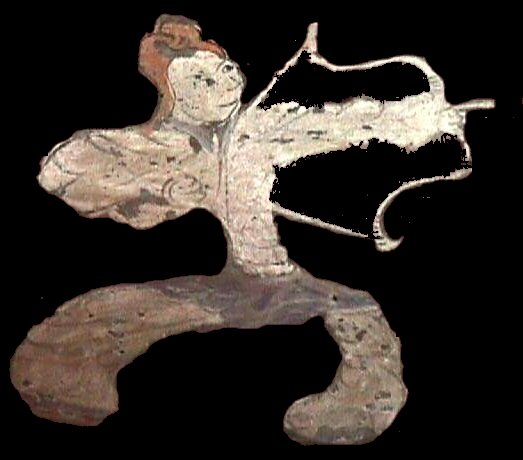
What Jack points out is important. These early Central Asian Turkish bows had a thickened portion before the tip which was roughly rectangular in section. I was using the word kasan as I understood Kani to use it, but it is not significant. I was attempting to contrast a bow with a triangular sectioned transition between the bending part and the tip to one with a rectangular section. In the old days we used to refer to this as the neck and the tip as the ear.
My point is: did these rectangular sectioned necks bend like contemporary Korean bows or were they rigid? Looking at the cross-section of the crab bow, it was clear that the basic shape of the core was rectangular with a microscopic ridge to guide the laying of the sinew.
It has occurred to me that by changing from a rectangular section to a triangular one, the bow maker was able to maintain rigidity without carrying as much weight. Perhaps the the rectangular section was replaced by one with a sinew ridge as in the crab bow, but then it was worked out that by making most of the ridge from the wood of the core a smaller amount of the relatively heavy sinew could be used.
comparative anatomy
-
Adam Karpowicz
- Posts: 753
- Joined: Sun Mar 13, 2005 11:57 am
- Location: Canada
"by changing from a rectangular section to a triangular one, the bow maker was able to maintain rigidity without carrying as much weight"
This is a very good observation and I have pondered for a long time why the sinew ridge had appeared in the kasan section of bows. In truth, the rectangular section can be made as rigid and as low mass as the triangilar section, when the proportion of the wooden core to the sinew backing are chosen correctly. I'd rather think the choice was made to follow a local tradition, not necessarily to improve the bows' performance.
We tend to look at any particular bow desingn as a deliberate, time proven choice, always leading to an improvement in cast. I am no longer so sure it is always the case.
Adam
-
Bede

- Posts: 2360
- Joined: Mon Mar 14, 2005 11:57 am
- Location: Sydney, Australia
Adam,
I completely agree. Local traditions and attempts to improve were not motivated by the scientific method. Trial and error were used I am sure just as we all do when making something. People learned by watching their masters or parents, not out of books or by being able to lay a whole lot of examples down on the table to compare them.
We are very lucky to be able to do what we are doing. Two hundred years ago, who in Turkey knew about Korean bows and vice versa?
I think that explains many of the inconsistencies we see in the development of bow design. My description of the possible development of the ridge was meant to show that the process could have happened without any conscious choice to design it but by making small changes to existing designs.
Do you think the triangular section was more stable regarding twisting when compared to a rectangular section of the same weight and stiffness?
Bede
-
jiao

- Posts: 663
- Joined: Fri May 06, 2005 1:24 pm
- Location: china
- Contact:
thanks for your thanks for pics same also.Dusan wrote:Jiao, thanks for pics. there is , i think no doubt that all variation of composite bow evolution was born an mostly changed i China (or near) teriritory.We only founding litlle pieces of history and try understand why, how , where ?...

yes , it is right we We only founding litlle pieces , when archaeology find more thread in tomb, when bioscience can reappearance all life a bowyer form his head, my proposition(all is china) is too big , are you think Egypt hornbow has any contact to china?it seem has no literate do some new research why, how, where
about china han hornbow,more pics find , it is not only one, literate do the research about han hornbow,crossbow,shoot technique:http://d.wanfangdata.com.cn/Periodical_ ... 10007.aspx
http://www.atarn.org/chinese/images/han_pot.jpg
about china tang bows, the short and longer and crab, has no any guess and professional comment on it?
-
jiao
- Posts: 663
- Joined: Fri May 06, 2005 1:24 pm
- Location: china
- Contact:
Several early Turkish bows have been excavated from tombs in Mongolia. They date between the 8th and 10th centuries. They have been published in catalogues of exhibitions about Chinggis Khan.Bede wrote:Jiao,
The kasan is clearly depicted in the Ming painting. The angle of the kasan to the working part of the limb at what is called the kasan eye is pronounced.

bede :
this pic is show a emperor of ming he go some where, 明世宗(1507?1566)朱厚熜,明朝第十一位皇帝),it save in Taipei's National Palace Museum,there consider he is other emperor 朱翊钧(1563年?1620年)
look at your hornbow adam send to you and adam call it turkish mix korean
my mean the early time turks is they are in china times before 6-8th ,see turks in china history here: http://www.microsofttranslator.com/bv.a ... 3dala0_1_1
-
Adam Karpowicz
- Posts: 753
- Joined: Sun Mar 13, 2005 11:57 am
- Location: Canada
I can not say the triangular section is more resistant to twist. Actually, it is rather the opposite (it is easier to correct twist in bows with triangular sections).
The triangular section could be a result of the ease of construction, plus the presence of the tip's V-splice. The splice's male tip's part is normally raised above the level of the female kasan's part (the tips have to be made of thicker wood than the sal and kasan wood). To keep the thickness of the core high as far as possible into the limb, the ridge is the best option. Also, even in the 3-part bows with no splice at the tips, when one uses an adze to form the core betw. the kasan and the tip, the sides of the core are safer to work down, as opposed to the inside of the bend, thus a triangle is made on the back of the core. I hope it is not too complicated.
Adam
-
Bede
- Posts: 2360
- Joined: Mon Mar 14, 2005 11:57 am
- Location: Sydney, Australia
Adam,
Thanks for the clarification. I like your idea for the development of the shape. The reason I was stressing the craftsman orientation on production was to suggest that just such a progression could occur. We twenty-first century people are so used to looking thinks up in books and on the Internet that we forget than most people in historic times would have seen little of the outside world. Even nomads had their territories which they migrated through.
Large states or very sophisticated ones could set up research groups. Dionysios of Syracuse is supposed to have done this to improve catapults. But it was very rare before modern times and not always successful because the ideas on how to rigorously test new weapons were not well developed.
Bede