
After i considered several options how to do splice of the ears in most of Serbian bows and after many discussions with our friend dr.Uli Wellner i've decided to accept two possibilities.
First one:ears made in one piece of wood as continuation of the limbs (Uli already approved this method).
Second one is more complicated but i think i have explaination why. I will consider this possibility here. To be honest i didn't discover this method, i get idea after i've read topic by Lurz in Norway and his attempt to reconstruct Moschevaya balka. Also, everyone who did pay attention on detached siyah of ancient Mongol Tsaagan khad bow discussed in German text can get a proof(or correct me).
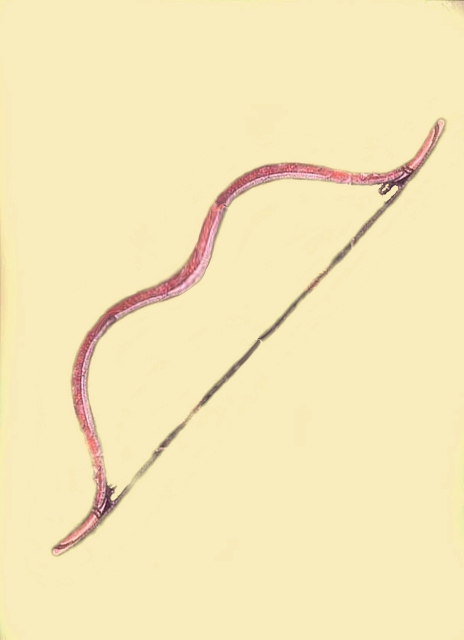
My idea is that as in most of nomadic bow types ears in Serbian bows could be made so that one lathe with groove is glued along the curvature and then shaped as it is exposed in my drawing made for Uli and our discussions. I also inserted this drawing/rough sketch on my facebook profile and Peter, Ivar,Ilia Levashov and Uli are in agreement that it can work well, though all of them think that groove isn't necessary in this case.
Why i've chosen this way of splice? I rejected common Hungarian method because if lathe would be glued onto the limb it would require huge sinew binding, not visible on the bows in Serbian mural painting. Opposite, there are always (should be) two thin separate sinew bindings colored in red at the base of the ears and at the grip. So,huge sinew binding isn't necessary in this way of splicing (my opinion) cause bow could get more in weight what i want to avoid.Serbian and even Saxonian (Sasi as ancient Serbian and other Balkans term) craftsmen even did stylizations on ears and it allows such stylizations. Bone plates are included.
I've chosen bow carried by st.Procopius in Lesnovo monastery built by Serbian Emperor Stephan Dushan,Rep.Makedonija (where center of Serbian state was moved at the end of XIII century).
Any advice,opinion or critic allowed.
Greetings,
Zoran
Rough plan for splicing the ears in Serbian bows
-
Zoran Pavlovic

- Posts: 219
- Joined: Mon Mar 14, 2005 2:01 pm
- Location: Serbia
Rough plan for splicing the ears in Serbian bows
You do not have the required permissions to view the files attached to this post.
serbianbow
-
Kalojan
- Posts: 17
- Joined: Wed Oct 05, 2011 8:26 am
- Location: Austria
I personally think, the first possibility is most plausible, but I would not say that the other possibilities aren't plausible, also the hungarian method, because we should also think of that, that the artists weren't for sure experts on weapons, so that they could have made some "mistakes".
I personally say: Look at the Ottoman Bows, and you will also see how a Bow from the Balkan Peninsula in the 14th century was made, despite the different shape (and if I take a look at the most frescoes, I see quite many bows of the "Crimean Tatar" and "Turkish" Type, specially the "Crimean Tatar" dominating). Fact is, that the Ottoman Influence in the Balkan Peninsula was enormous, maybe allready at the Time of Sultan Orhan Gazi.
I personally say: Look at the Ottoman Bows, and you will also see how a Bow from the Balkan Peninsula in the 14th century was made, despite the different shape (and if I take a look at the most frescoes, I see quite many bows of the "Crimean Tatar" and "Turkish" Type, specially the "Crimean Tatar" dominating). Fact is, that the Ottoman Influence in the Balkan Peninsula was enormous, maybe allready at the Time of Sultan Orhan Gazi.
-
jack farrell
- Posts: 1864
- Joined: Sun Mar 13, 2005 3:40 am
- Location: Texas
-
Kalojan
- Posts: 17
- Joined: Wed Oct 05, 2011 8:26 am
- Location: Austria
http://atarn.net/phpBB2/viewtopic.php?t ... torder=asc
Date is around the mid 14th Century (I think 1340s)
(Sorry for my quickness
 )
-
jack farrell
- Posts: 1864
- Joined: Sun Mar 13, 2005 3:40 am
- Location: Texas
-
Kalojan
- Posts: 17
- Joined: Wed Oct 05, 2011 8:26 am
- Location: Austria
Its made by Zoran. You can see in his thread how he made this picture.

This is the frescoe
http://fotki.yandex.ru/users/liblion/album/74296/
Here more pictures from the Monastery
This is the frescoe
http://fotki.yandex.ru/users/liblion/album/74296/
Here more pictures from the Monastery
-
Zoran Pavlovic
- Posts: 219
- Joined: Mon Mar 14, 2005 2:01 pm
- Location: Serbia
#Kalojan (Sergej?),
I do not think that there's a reason to exaggerate influence of Ottoman Turks during the rule of sultan Orchan Gazi. It is a fact that Sultan Orhan participated civil war between two pretenders on Byzantine thron but it still didn't mean that Balkan countries were under enormous Ottoman influences before conquest of Galipoli and moving the capital in Adrianopolis (Edirne, Jedrene) in 1369 entering Europe. Serbs,Bulgarians and Greeks were defeated by Ottomans few times e.g. Battle at Stephaniana (1344) and Dimotika later but it was only episode bearing in mind that these Ottoman troops mostly weren't regular troops but mercenaries involved in civil war in Byzantium.
Real influence started in the first decades of XV century (when Serbian Despotate and most of other Balkan countries were already vassals of Ottoman Empire) and it if we are talking about Turkish bows influence only one of them appears in Serbian mural painting at this time, though influence is visible in sketches of Italian painter Pisanelo during visit of Byzantine emperor John VIII Paleolog.Also, frescoes in Kremikovski monastery in Bulgaria and Poganovo in Serbia content frescoes with ''turkish like'' bow type.
In English language there's clear distinction between words Tukic and Turkish which is not case in our languages, Serbian and Bulgarian. So, depicted Serbian bows were of Cuman and Tatar influences at the end of XIII centure and with beginning of XIV century owing to Cuman and Tatar mercenaries.Short bow form you can find in Hungarian Chronnica Picta and it was for sure of Cuman and Tatar origins since both of them had big influence not only in the armies of Balkans.Entire equipment is most of nomadic fashion specially including closed quivers often with the lid though Serbian and even possibly Saxonian craftsmen gave them their stylizations and sign.Also, there's early Byzantine reliefs with representation of short form bows. If you take a look at Wu bei zhi you can see Ming bows with shorter form and ears shaped similar as in Serbian bows.
Yes, reconstruction of st.Mercurios's bow you've inserted is made by me but as it always happens in the researchs first version can be replaced by second one. I wasn't exact and precise about this reconstruction since bow is longer and this is only bow with, as you mentioned, ''Crimean tatar'' feature. Crimean Tatar bow is invention of later times and i am sure it is improved older Turkic/Tatar bow type. I will insert second version but it is not still exact because ears should be more angled.
#Jack;
Kalojan already inserted mural. I will insert another one.If you do observe it closer you'll notice that tips are not of modern recurve type. I've chosen these two ones because they are easier to me to replicate.About entire bow plan i will insert it soon since my scanner is out of function at the moment. Did you mean to insert plan with all measurements?
Frescoe i inserted is St.Procopius from Lesnovo.
Greetings
You do not have the required permissions to view the files attached to this post.
serbianbow
-
Kalojan
- Posts: 17
- Joined: Wed Oct 05, 2011 8:26 am
- Location: Austria
The Ottoman Influence was, mentioning to many authors like for example David Nicolle and Ian Heath, even for the periods earlier:
PS: Yes, its me (but its my old nickname, I don't use for nearly 2 Years)
This means that the Painting by Pisanello (btw. He is depicting the Fall of Empire of Trebizond 1465, meaning that it is in Fact a Post-Byzantine depiction) and the Frescoes of the Kremikovtsi Monastery (which were made in 1493, more than 100 years after the Fall of the Bulgarian Empire). Just look at the appearence of Sabers, and Balta-like Axes. And also began in this times the movement for lighter armored forces (as we can see in Bulgaria and Byzantlum very good). But also look at the Manuscripts, specially Manasses Chronicle, Serbian Psalter, and also the Alexander Romance from the 1350s, in which the Byzantine Soldiers wear TURKISH trousers, (poturi or shalvari).David Nicolle "Arms and Armor of the Crusading Era Vol.2"
Wallpaintings, Byzantine-Macedonian, c. 1295 (in situ Church of St. Kliment, Ohrid, Macedonia
....These wall paintings in Ohrid include a number of interesting new features, the most striking of which is the curved saber of St. Mercurios, Its appearance here, more than a half century before the Ottoman Turks crossed into Europe, indicates that Byzantium, and probably other Balkan areas, were already under strong Turkish influence. This would have stemmed at least as much from steppe peoples north of the Black Sea - some of whom fought for Byzantium as mercaneries - as from the Islamic Turkish regions in Anatolia.....
PS: Yes, its me (but its my old nickname, I don't use for nearly 2 Years)
You do not have the required permissions to view the files attached to this post.
-
Uli

- Posts: 600
- Joined: Sat Aug 13, 2005 7:33 pm
- Location: Saxony (home), Baltic (now)
-
Zoran Pavlovic
- Posts: 219
- Joined: Mon Mar 14, 2005 2:01 pm
- Location: Serbia
-
Uli
- Posts: 600
- Joined: Sat Aug 13, 2005 7:33 pm
- Location: Saxony (home), Baltic (now)
Zoran, I insert the pics you refer to:
the Arcat Del bow (see former post) from the work of Ulambayar Erdenebat.
the detail pic of the broken-off siyah has the groove you mention.
there are no siyah bone plates but a bone plate supporting the back of grip
total length estimated 135-140cm, C14 date 11th century
length of quiver 90cm
the Arcat Del bow (see former post) from the work of Ulambayar Erdenebat.
the detail pic of the broken-off siyah has the groove you mention.
there are no siyah bone plates but a bone plate supporting the back of grip
total length estimated 135-140cm, C14 date 11th century
length of quiver 90cm
-
Zoran Pavlovic
- Posts: 219
- Joined: Mon Mar 14, 2005 2:01 pm
- Location: Serbia
-
Uli
- Posts: 600
- Joined: Sat Aug 13, 2005 7:33 pm
- Location: Saxony (home), Baltic (now)
-
Uli
- Posts: 600
- Joined: Sat Aug 13, 2005 7:33 pm
- Location: Saxony (home), Baltic (now)
-
jack farrell
- Posts: 1864
- Joined: Sun Mar 13, 2005 3:40 am
- Location: Texas
Zoran; I agree with you in picking out one or two bows as representative of the type you wish to reproduce rather than trying to incorporate traits from all examples. Military weapons were not standardized at the time.
I will give one caveat and that is that the accuracy at guessing the construction of a bow type without any artifacts would be very poor indeed.
However, I must agree with Kalojan that the construction most likely incorporates Turkic construction at the late date of the mural, 1300s. The V- spliced ears leave a stronger bend than the layering in a Hunnic type bow and V-groove, Turkic type construction becomes ubiquitious (but not universal) by this period. The older Hunnic type construction has wrappings at the recurves and above the grip if the bow is not entirely wrapped. What looked like a modern flat recurve is probably a long loop on the bow string.
The Arcat Del bow tip appears to have the older type small loop as the ghost of the string is easy to see on the fragment.
If I was building this bow I would construct it in the manner of a Korean bow; two limbs in one piece bent in the middle with a strong riser glued on, V-spliced on ears which were pre bent, maybe an extra piece to fill in the tall end nock piece.
This is merely an educated guess, or maybe not educated.