
Korean Vs. Turkish Bow
-
daryush
- Posts: 228
- Joined: Thu Apr 09, 2009 7:49 am
- Location: Nottingham, UK
-
Bede

- Posts: 2360
- Joined: Mon Mar 14, 2005 11:57 am
- Location: Sydney, Australia
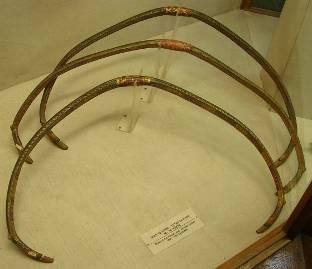
There is a Hunza bow in the Grayson Collection. It is a derivative of the later steppe bows which is roughly assembled and which had non-contact siyahs in its present form. There are strong relationships to other Indo-Persian bows.
Perhaps we should be clearer about what is meant by Moghul/Mughal bows. The composite bows used in the Indian subcontinent were divided into four classes by the people living there and the descriptions are in the Hidayat ar-Rami. The easily recognised ones are the Chahar Kham (four curved bow) or the Sind bow, the Moghul bow (which resembles a Persian bow in strung shape), the crab bow and the Kashmiri bow. This is not a definitive description of those four types. I have some problems understanding the descriptions of bows I have not seen and I am using working translations that might be refined later.
It is important to realise that the bows made in the eighteenth and nineteenth centuries may have the external form of earlier bows, but the constructional methods may be those of the location where they were made.
It is easy to think that because a bow had roughly the same profile as another that the construction and the history is the same, but this is not true. Personally I think that the appearance of the triangular section kasan is the turning point in bow construction between the contact and non-contact siyah. Many authors have drawn a comparison between the early non-contact siyah bows of the Liao and Jin dynasties and the later Manchu bows. There were linguistic, geographic and ethnic relationships between the three peoples, but the non contact Jin bows only had similar siyah to limb proportions. Excavated bows show they were of the old construction of the previous thousand years and not the later Ching recurved construction.
The change in how bows were put together (the introduction of the "V" splice) and the way they operated (recurved tips) must have happened over several centuries. Using art and archaeology to identify the turnover point is imprecise. The chance finds of bows might be of some backwater where old technology dominated. The artist's rendition may contain stylisations that had been handed from master to pupil instead of direct observations.
Having said that, I have found another clear representation of a recurved tipped bow in the Dietz Album, a collection of pages from the World History of Rashid ed-Din. This copy is dated 1330 and is now in Berlin. Most of the other bows in the painting look transitional, but one has clearly recurved tips. The transitional bows have elements of the recurve but are drawn as straight non-contact eared bows. It would be easy to assume that several types of bows were in use at the same time and that one came to dominate.
Bede
-
jack farrell
- Posts: 1864
- Joined: Sun Mar 13, 2005 3:40 am
- Location: Texas
Bede; Welcome back, was wondering if you were writing something or vacationing.
I find the profile of a strung bow in artwork as an unreliable indicator of structure and cultural affiliation. Except for Rashid who sets a duifferent standard for artwork. He was after all preparing a history of Mongol conquest and more.
I prefer to rely on artifacts and ethnographic collections if the provenience is good.
Much of Afghanistan was under Mughal control during the period. Grayson' Hunza bow is like one in the Koppedrayer collection and one i photoed in Tashkent, Uzbekistan. It is a long, crude hornbow painted black with multiple thin belly slats and sinew lashings at intervals. There is no kasan and no indication of siyah splice. Arrows are like massive Qing and the quiver is similarly constructed.
Grayson's Hunza.
-
Bede
- Posts: 2360
- Joined: Mon Mar 14, 2005 11:57 am
- Location: Sydney, Australia
Jack,
I have been staying in the US with the Koppedreyers and we have been on the road much of the time so checking in was not easy. I have seen their bow and it is a cousin of the Grayson one. The crudeness of construction may be the result of a gradual loss of the technology as bows became less important or it may represent a folk tradition in the area.
The illustrators of the various editions of Rashid ed-Din's history had different priorities than we do. They were not trying to give diagrams of bow construction nor were they trying to separate weapons into ethnographic types. However, when something significant like a recurve appears, it is worth considering even if it is not conclusive. In one illustration, you can find many ways of depicting a bow. The illustrators seem to have been experimenting with different ways of representing the world.
In general I agree that an illustration is not a definitive method for identifying a bow, but since there seems to be a common practice now of illustrating archaeological discoveries out of context (e.g. tenth century bows used to illustrate a book about the twelfth and thirteenth century Mongols), we must make the best judgements we can.
Bede
-
daryush
- Posts: 228
- Joined: Thu Apr 09, 2009 7:49 am
- Location: Nottingham, UK
Thanks for the info regarding Hunza bows. I might have seen one in a monastery museum in Leh, Kashmir, but unfortunately photography wasn't allowed. At first I thought it was a very large and poorly made Turkish bow. It was braced and looked like a quarter circle with siyahs at the same sort of angles as you see on Turkish bows but slightly longer. It was also extremely big. Unfortunately the lighting wasn't good enough to see if it had lashings or finer details of the construction.
In the same city I also saw a crab bow and a chahar kham. The crab bow was quite small, I think it would only just have been 90 cm - 1 metre strung. I don't know how large these normally were but Jaap Koppedrayer's and Grozer's versions are much bigger. The chahar kham was broken and not strung, but it wasn't very big. It might have been 80 cm unstrung, measured in a straight line from both nocks (an unconventional way of measuring but I can't measure curves in my head very well).
There was also a crab bow in Jaipur which had a limb width of 10 - 12 cm (estimated).
Do you have any pictures of the Kashmiri or Mughal/Persian bow? How are they different to the chahar kham and crab bows?
-
Bede
- Posts: 2360
- Joined: Mon Mar 14, 2005 11:57 am
- Location: Sydney, Australia
The Mughal style of the Persian bow has the angle at the base of the siyah almost the same as the angle of the tip to the ridged part of the siyah. This can be done with Turkish construction, but was usually done in the Persian style with multiple strips of horn on the belly.
I have seen composite bows from Kashmir, but I am not sure if they are the Kashmiri style or just a variation on the Mughal type. The illustrated page was on the WWW at some stage and a bow of one of the types has been illustrated on this site in the past. I have tried to get the link but have failed so far.
I have seen composite bows from Kashmir, but I am not sure if they are the Kashmiri style or just a variation on the Mughal type. The illustrated page was on the WWW at some stage and a bow of one of the types has been illustrated on this site in the past. I have tried to get the link but have failed so far.
Bede
-
daryush
- Posts: 228
- Joined: Thu Apr 09, 2009 7:49 am
- Location: Nottingham, UK
If anyone is doing any research there, give me a PM - it's something I'd love to get into but am unable to do any on my own.Thomas Duvernay wrote:One interesting aspect is the relationship between language and horn bows. Many of the so-called Altaic languages were also horn bow cultures. I bet that could make a good research topic for someone so inclined.
-
mongolianarcher
- Posts: 299
- Joined: Thu Jan 22, 2009 12:51 am
- Location: Florida
You are completely right about the Altaic language correlation. I wonder how someone could prove the causation of the "Altaic language branch". Maybe traderoutes? So your question meant to find out if Altaic language relationship is true? Or how it may have come about?
xie xie, thank you
Lu Ka Jiang,
Lucas Cooper
Lu Ka Jiang,
Lucas Cooper
-
jack farrell
- Posts: 1864
- Joined: Sun Mar 13, 2005 3:40 am
- Location: Texas
Thomas' statement about the correlation between language and bow type is interesting. Korean is a Ural-Altaic language and this vast area is well within an area thought to be ancestral to horn bows. However, bow development was so prone to passing cultural barriers and of such great antiquity that it seems like an exercise in futility to name some start place for a type.
According to Duvernay, Korean archery was redefined for target purposes early in the 20th century. There are several large Korean made war bows in the Military museum and their publication. These bows are longer and much more robust than target bows.
Turkish type bows were almost certainly developed in Central Asia and refined in a thousand workshops from there to Europe and in between. A Korean bow is built on the format of the Turkic bow, as were the majority of other late types. I assume the types to be of comparable construction.
-
Stephen Selby

- Posts: 1452
- Joined: Thu Mar 10, 2005 1:10 pm
- Location: Hong Kong
- Contact:
Yokhua, the more I look at these Han images, the more that I am convinced that they show Xiongnu and Saka enemies / occasional allies of the Han Chinese. That is particularly striking when you see the battle scenes on some of the Han tomb walls in Shandong.yokhua wrote: To prove? Easy! just look at Stephen's Avatar, that image were how old? 2,000 years? Isn't the size and profile of that bow looks like so called "Tat-Tar" , "Korean" or "Turkish"....
-
ginni

- Posts: 250
- Joined: Fri Jan 12, 2007 7:09 pm
- Location: romania
- Contact:


-
Dusan
- Posts: 990
- Joined: Sat Jun 30, 2007 6:29 pm
- Location: Slovakia
You are right Ginny. We talked about same problem in another place. People was surprised . First time some Atarns closer see ridge in old Korean bows. This bows must function closer like tatar bows, than todays korean sporting bows .
In another poin was more trouble vith construction ridge tipe bow than "simplie" todays Korean bow who working in most his bending partclose to the tip. For me is more "shock" that most of that old bows was describe like all wood kompozite vithout horn !
In another poin was more trouble vith construction ridge tipe bow than "simplie" todays Korean bow who working in most his bending partclose to the tip. For me is more "shock" that most of that old bows was describe like all wood kompozite vithout horn !
-
ginni
- Posts: 250
- Joined: Fri Jan 12, 2007 7:09 pm
- Location: romania
- Contact:
-
Bede
- Posts: 2360
- Joined: Mon Mar 14, 2005 11:57 am
- Location: Sydney, Australia
Ginni,
I know that the smaller hand bows with wooden bellies were enclosed in sinew. The larger war bows may not have been. I haven't seen enough to be certain. The very strong wooden bellied crossbows were spirally wrapped in sinew. I saw one where the lacquer had fallen off and the sinew had become loose. The crossbows did not have ears (siyahs).
I know that the smaller hand bows with wooden bellies were enclosed in sinew. The larger war bows may not have been. I haven't seen enough to be certain. The very strong wooden bellied crossbows were spirally wrapped in sinew. I saw one where the lacquer had fallen off and the sinew had become loose. The crossbows did not have ears (siyahs).
Bede

