
How to use cylindrical thumb ring ?

This is where we discuss techniques used in Asian archery.
Post Reply
User avatar
orange
Posts: 37
Joined: Fri Sep 26, 2008 8:11 pm
Location: Prague,Europe

How to use cylindrical thumb ring ?

Post by orange » Wed Nov 04, 2009 10:16 am

How to properly use cylindrical thumb ring like this ?

Image

Source: Chinese Thumb Rings: From Battlefield to Jewelry Box

Best will be some instructional video.

Background: I am practicing for some year a Chen Tai Chi so I am curious to try how Chinese practice Archery.
Last edited by orange on Sat Nov 07, 2009 5:45 pm, edited 2 times in total.
Ken
Posts: 28
Joined: Fri Sep 18, 2009 2:47 pm
Location: Scotland

Post by Ken » Wed Nov 04, 2009 10:51 am

Just the question I wanted to ask as well. I had thought the string would lie against the face of the ring as per the rings with a lip (and a groove) but having bought Kays Thumbring Book recently I find her diagrams showing rings such as this with the string not on the face but on the edge, alongside the thumb. This would appear to be an entirely different style of release with the thumb and fingers taking up different positions?
daryush
Posts: 228
Joined: Thu Apr 09, 2009 7:49 am
Location: Nottingham, UK

Post by daryush » Wed Nov 04, 2009 5:09 pm

I thought that the string would lie against the circular part of the cylinder against the thumb. How would it work if it rested against the long part?

Where do you get these rings from anyway? I've been looking for one ...
M??a
Posts: 69
Joined: Tue Jul 01, 2008 9:43 pm
Location: Prague

Post by M??a » Wed Nov 04, 2009 6:02 pm

Ken
Posts: 28
Joined: Fri Sep 18, 2009 2:47 pm
Location: Scotland

Post by Ken » Wed Nov 04, 2009 6:45 pm

Sorry but that photo is indecipherable - just a black blob - on my screen
M??a
Posts: 69
Joined: Tue Jul 01, 2008 9:43 pm
Location: Prague

Post by M??a » Wed Nov 04, 2009 7:22 pm

I will try next photo
Last edited by M??a on Wed Nov 04, 2009 10:16 pm, edited 1 time in total.
M??a
Posts: 69
Joined: Tue Jul 01, 2008 9:43 pm
Location: Prague

Post by M??a » Wed Nov 04, 2009 7:24 pm

M??a wrote:I?m sorry. Itś problem with using flashlight. Maybe this will be better
Image
Image
User avatar
Bede
Posts: 2360
Joined: Mon Mar 14, 2005 11:57 am
Location: Sydney, Australia

Post by Bede » Wed Nov 04, 2009 11:21 pm

Most rings of this form that were intended for shooting had one end tapered from the inside to the outside and the other with a taper from the outside to the inside. When worn, the outside tapered portion was towards the hand. This was where the string rested.

If you wear the ring close to the base of the thumb as shown in some western illustrations, the string inevitably presses on the tendons running from the hand up the inside of the thumb (these are the ones responsible for closing the thumb). This makes it very uncomfortable with strong bows.

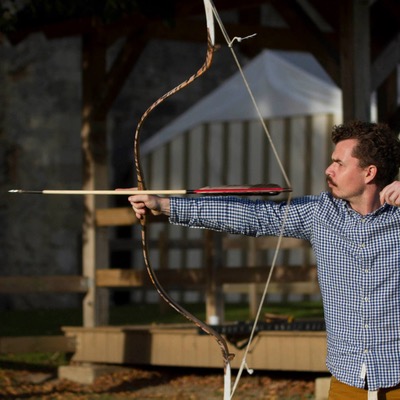
The technique shown in several old photographs and in diagrams republished in Chinese Archery by Stephen Selby has the ring on the centrally on the thumb. This means that the knuckle of the thumb (the distal joint) is inside the ring and only the nail and its base are visible on the outside. So, unlike a middle Eastern ring, the thumb is not hooked through the ring. The thumb is bent so that the two inner surfaces of the thumb press against one side and the knuckle presses against the other. With this grip, you should not be able to pull the ring off your thumb until you straighten the thumb.

The three fingers, middle, ring and small, are tightly clenched like the Middle Eastern styles. However, instead of the tip of the thumb being pressed against the middle section of the middle finger, you press the outside surface of the ring against the middle finger. The forefinger is lightly curled over the thumb nail touching the upper end of the ring. As in Middle Eastern archery, you can hold the arrow in place with the side of the forefinger.

To release the string, you straighten out the forefinger, but you do not straighten the thumb and instead open it from the base knuckle (the proximal joint of the thumb). The follow through results in the drawing hand pointing directly away from the target in a similar manner to the Japanese kyudo stance.

These rings are good for long draws. They come in thick and thin forms. The thin ones give a faster release. The thick ones are easier to learn with.

There are good photographs of this technique by an old Manchu archer elsewhere on the site.
Bede
daryush
Posts: 228
Joined: Thu Apr 09, 2009 7:49 am
Location: Nottingham, UK

Post by daryush » Wed Nov 04, 2009 11:45 pm

Bede wrote:If you wear the ring close to the base of the thumb as shown in some western illustrations, the string inevitably presses on the tendons running from the hand up the inside of the thumb (these are the ones responsible for closing the thumb). This makes it very uncomfortable with strong bows.
Thanks for the info Bede. But I have to comment on this part.

I use my Hungarian made thumb ring as a cylindrical ring (it looks like a cylindrical ring with a tiny - 5 mm - lip), and end up placing the string behind the ring touching my thumb. I end up angling my wrist so that there is very little pressure applied to the thumb tendons, but so that I can still lightly feel the string on my proximal thumb section. I'm drawing around 70 lb at 32 inches, and there is no pain.
User avatar
JJ
Posts: 317
Joined: Mon Dec 08, 2008 9:38 am
Location: Germany

Post by JJ » Thu Nov 05, 2009 3:00 pm

Mysa, you?re an artist! Incredible job on the arrows in the pics... or is it old originals????

JJ
Ashbow
Posts: 224
Joined: Tue Apr 22, 2008 4:17 pm
Location: Poland

Post by Ashbow » Thu Nov 05, 2009 3:05 pm

JJ, if only you could see Mysa's blacksmithing work... :)
M??a
Posts: 69
Joined: Tue Jul 01, 2008 9:43 pm
Location: Prague

Post by M??a » Thu Nov 05, 2009 3:48 pm

JJ wrote:Mysa, you?re an artist! Incredible job on the arrows in the pics... or is it old originals????

JJ
it is old original. I made this set a month ago. I have new set at pressent. On my actually arrows is geometry turned slight more to nock :lol:
Alan Flashing
Posts: 181
Joined: Fri Jul 18, 2008 10:36 pm
Location: Oakland Oregon,USA
Contact:

arrowss

Post by Alan Flashing » Thu Nov 05, 2009 4:05 pm

Outstanding arrows as always Mysa. Great art work, and nocks!
Alan
User avatar
Peter Dekker
Site Admin
Posts: 171
Joined: Sun Oct 01, 2006 11:21 pm
Location: the Netherlands
Contact:

Post by Peter Dekker » Fri Nov 06, 2009 4:08 pm

daryush wrote:
Bede wrote:If you wear the ring close to the base of the thumb as shown in some western illustrations, the string inevitably presses on the tendons running from the hand up the inside of the thumb (these are the ones responsible for closing the thumb). This makes it very uncomfortable with strong bows.
Thanks for the info Bede. But I have to comment on this part.

I use my Hungarian made thumb ring as a cylindrical ring (it looks like a cylindrical ring with a tiny - 5 mm - lip), and end up placing the string behind the ring touching my thumb. I end up angling my wrist so that there is very little pressure applied to the thumb tendons, but so that I can still lightly feel the string on my proximal thumb section. I'm drawing around 70 lb at 32 inches, and there is no pain.
I think the difference is in the lip, no matter if it is tiny. The true cylindrical rings don't have a lip, but rather an edge. Other than lipped rings, that divide the pressure of the string over a large area, cylindrical rings still transfer much of the string's pressure on a single point. If that point is at a tendon, it will hurt. Your lip probably evens out the pressure more at the part that would otherwise push into the flesh.

I practice with antique Manchu rings, so there is no question on the authenticity of their geometry. I began using them because all cylindrical reproduction rings I used hurt. When the antique ring hurt as much as the repro's, I realized the problem was with me and not my equipment.

The technique Bede explains appears to be the correct technique, and the best I've tried to date. It still hurts sometimes when I use heavier bows but that's probably just down to lots of practice and making some minor adjustments.

-Peter
User avatar
Peter Dekker
Site Admin
Posts: 171
Joined: Sun Oct 01, 2006 11:21 pm
Location: the Netherlands
Contact:

Post by Peter Dekker » Fri Nov 06, 2009 4:33 pm

By the way the "twisting" of the draw hand described in some Chinese manuals only really start to make sense when using a ring like this. It locks it up so well that there is no real need for the index finger anymore in holding the string.

Here some more pictures. The string is not very tight as I attached it on two points to the wall in order to make the pictures, instead of pulling a bow, so I had my other hand free.

Image
String rests behind the rounded edge of the ring. Index finger can go around, but doesn't need to. (Qing archers used it to keep the feathers of the arrow away from the bow then pulling.)


Image
An exaggerated view of the twist one gives the hand, that is described in a few manuals. With drawing real weight, the effect will hardly be visible of course, but I hope this picture gives a clear image of what is meant. The base of the index finger pushes the string against the ring.

Image
View from the other side, as often seen on pictures of Qing archers.

See this picture from the ATARN site for comparison:
Image

(I am a left handed archer, the mirror image of most of you.)

-Peter
Post Reply