Very close (arm) distance training target (Torba, Makiwara)

This is where we discuss the bows, arrows, quivers and other hardware used in Asian archery.
Post Reply
User avatar
orange
Posts: 37
Joined: Fri Sep 26, 2008 8:11 pm
Location: Prague,Europe

Very close (arm) distance training target (Torba, Makiwara)

Post by orange » Fri Nov 13, 2009 9:56 am

Last 2008 autumn/fall I start think how I can practice archery shutting during winter when is very child and cold in our country for along period of about 4 months. Shutting in clubs is expensive and is anyway on 18m hall distance only.

I have at my house a small room (max 2.5m length) which my wife allow me to occupy for archery, with some strict RULES, one of them was you will be quited at time then my child are sleeping.

Because of shot distance smaller then needed ~ 5M/6ft for stabilizing S bending effect arrows, I was not bale to use successfully classic target constructions. They was or too hard and arrows jump back to me or to soft so my 45lb/30" and 65lb/30" bows send arrows thou it in few dozen of shots or target was too stiff inside and wooden arrows beaks inside, plus this types of solid target was loud.

Yes, in archery shop where was simple answer, buy a Olympic bow and this training device (Device cost $100):

Image

Initially I experiment with my compound target solution , but later I start dig how old archer was learning and I found 2 interesting sources of inspiration:

- Turkish Torba
- Japanese Makiwara
( May there are more in Chinese in Korean Archery ? )

Base on them I made my Very close (arm) distance training target and I was using it last autumn/fall. I will here share my experience with building and use of similar device.

I will be pasting some infos from old post made on June / 2005, read the
whole post for full context Technique - Some questions for Bede (and interested)

PS: Later I will explain then will better will be write Very close (arrow) distance target, but caption is too small :lol:
Last edited by orange on Fri Nov 13, 2009 8:46 pm, edited 6 times in total.
User avatar
orange
Posts: 37
Joined: Fri Sep 26, 2008 8:11 pm
Location: Prague,Europe

Post by orange » Fri Nov 13, 2009 9:59 am

This is initial try and experience before Torba/Makiwara inspiration:

I want small compact indoor training target I can use regularly in day-to-day practice 6 arrows X 10 repeats for both my 45lb/30 and 60ld/30" bows in room of 1,8m x 2.5m size.

Initial design was simple, I use a computer packaging recyclable waste from servers (you can find similar waste for recycling in many shops for free):

Image

Cardborad box paper, crumpled stretch very thin packing foil, soft lather foam polyethylene (don't use fragile polyester from while bubbles), under old capret.

Stretch very thin packing foil for final wrapping

Image

Close range target must solve one issue, distance is not long enough and arrow will still bending in S shape, see:

Physics Of Archery — Archer's Paradox

Archers Paradox - Super slow motion video

S bending have enough power to break arrow, so we need a ideal target with contradicting requirements:

- it must allow to let finish bending (to be soft ???)
- it must absorb arrows energy to stop it ( to be hard ???)

I try solve it by making an assembled dual zone target like this:

1. Entry zone (Front part) was one peace from box cardboard paper

!!! This zone must be REALLY soft or arrows can bounce back and hit you !!!

2. Flexible zone was large cardboard box of 20cm in deep with crumpled packing foil (Important: There must be enough space left when crumling a foil so arrow can a little move inside, when it hit box)

3. Landing zone was large cardboard box of 40cm in deep fully filled with pressed soft lather foam polyethylene material using to hold computers or toher stuff in box during shipment.

4. Stop zone was done was 3x old carpet (only part from my home), you can put there a more hard recycled thick paper used to hold heavy parts in cardboard boxes (opposite to cardboard paper this can be easily bend)

Everything was well packed together by stretch packing foil 5 times around.

As arrow to help minimize S effect I use a cheap harder aluminum arrows +10LB spine and normal points.

Target size was about 140cm x 90cm, each day I shut in different target place, once in 2 weeks I exchange front paper and mix foil in flex zone.

It works in some extend, but if was huge as most god solid targets are.

By time a soft lather foam polyethylene zone 3 get tease and I start looking for something else, instead of redo same again target.

PS: Mirelon is Local Check brand for soft lather foam polyethylene material, its very similar to waste this waste.
Last edited by orange on Tue Nov 17, 2009 9:30 am, edited 11 times in total.
User avatar
orange
Posts: 37
Joined: Fri Sep 26, 2008 8:11 pm
Location: Prague,Europe

Post by orange » Fri Nov 13, 2009 9:59 am

So 2 layer target from waste was not ideal solution, I start looking for more proven one and I was able to find on net comments like this one:

BeDe (June/2005)
The training exercises in the Middle East were very similar to the Japanese makiwara practice where you shot into a close soft target with unfletched arrows from a weak bow until you had achieved perfect form and arrow flight. According to Murat the Turks also shot heavy bows in the same way. This allows you to practise without worrying about the target and aiming. You build the foundation of shooting without distraction.

I follow them and I was really surprised how compact Turkish target is !

I start to dig more info about them and experiment with their possible constructions.
Last edited by orange on Fri Nov 13, 2009 8:48 pm, edited 6 times in total.
User avatar
orange
Posts: 37
Joined: Fri Sep 26, 2008 8:11 pm
Location: Prague,Europe

Post by orange » Fri Nov 13, 2009 10:04 am

Turkish Torba

When Murat was in Vsetice he spoke about this Turkish Torba training target:

Torba is close range training target build as long wooded box filled with fleece or cotton wool. Stand will allow to regulate a hight and angel.
Practitioners shut from very shot distance with unfleched arrows and they try to make arrow in target strait to Torba longer line.

They push inside various materials, most common for most stronger bows they use a mix of cotton wool and wooden sawdust, box is really simple wooden one.

Note: From my experience one of material really need to be a stand based and it need to be in lint from (as irregular in thickness and length) to torba work properly.
I will explain it later when I will be comparing Troba solution with Makiwara one.

Image
Indoor flight shooting practice. ("Okspor" archery clube, 1939)

Qualifications and Training of the Turkish Archers

Torba mean in many Slovanian languages mean bag like part of originally army dressing.
Last edited by orange on Fri Nov 13, 2009 8:50 pm, edited 12 times in total.
User avatar
orange
Posts: 37
Joined: Fri Sep 26, 2008 8:11 pm
Location: Prague,Europe

Post by orange » Fri Nov 13, 2009 10:07 am

Japanese (kyudo) Makiwara

Makiwara kyudo - A close range target, form as tightly bound drum of straw.

From book Kyudo: the essence and practice of Japanese archery (By Hideharu Onuma, Jackie DeProspero):
When space is at a premium, kuydo is practiced at a makiwara
Makiwara is produced in 4 sizes: Extra small, small, medium, large

Usage:

Makiwara is really old time proven technique , see translation of Japanese text from 1634 Makiwara Madenss

For short distance shooting at one bow-length away, a makiwara is used as a target. A makiwara is a straw practice target that is shot at from a bow's length away.

The makiwara is shot at from a very close range (about seven feet, or the length of the archer's strung yumi when held horizontally from the centerline of his body).

Kyudo beginners start to shoot to makiwara (Makiwara-mae) before moving to 28 meters shooting 28 (Mato-mae). Makiwara however, is not only used by beginners but also by expert kyudoka, both as warm-up at the start of kyudo training session and to study certain aspects of their shooting without the “distraction” of the target.

Traditionally, it is a drum of straw on a stand. It’s made of rice straw cut and bound together. It is common here to use straw or hay bales wrapped in a white sheet to make handling and transport a little neater.

In this type of shooting it’s used an arrow that differs from the one used in the 28 meters shooting for two characteristics:

- It has very small or no wings. These are not necessary due to the short distance covered by the arrow to reach the makiwara

- It has a different kind of tip. This tip, ogive shaped, is designed to minimize the impact of the arrow on the straw and then allow a longer life to makiwara.

Because the target is so close and the shot most certainly will hit, the archer can concentrate on refining his technique rather than on the arrow's arc.

In the year preceding his examination for Hanshi (Master's Certification) Onuma sensei practiced almost entirely at the makiwara; saying that it helped him concentrate on the most crucial element of successful shooting - himself.

It is important to note that makiwara practice is not, in any way, inferior to full-distance practice.

Many of the world's kyudojo are used exclusively as makiwara dojo.

For makiwara are used special arrows Ya, they have different smaller fetching and points are simple round shape similar, original pint was from horn to less damage makiwara, see pictires bellow.

Image

Image

Note: Based on links cited near pictures (yumi is Japanse Kuydo bow).

Some makiwara photos:

Image

Source Kyudo Equipment

Image

Image

Source makiwara

Image

Source: Kyudo: Way Of The Bow - Part 2

Image

Source: Kyūdō

Image

Image

Real office use :roll:

Image

Nylon makiwara :wink:

Image

Makiwara with aditional protection

Image

Nomarly Makiwara is strait, but is also a variants under angle

Image

Image

Image

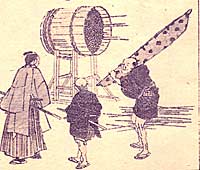
A wooden barrel stuffed with straw is used as a makiwara as seen in this historic woodblock print from the 1870s. (Courtesy of Christopher Caile)

Source: Kyudo: Way Of The Bow

Makiwara is often displayed with yumi (bow) and ya (arrows)

Image

Source: The Tools and Practice of Kyudo

Last edited by orange on Sun Nov 15, 2009 7:27 am, edited 14 times in total.
User avatar
Jos?Dom
Posts: 236
Joined: Fri Jun 06, 2008 3:04 am
Location: Argentina

Post by Jos?Dom » Fri Nov 13, 2009 5:07 pm

Turkish training for flight shooting
Image

http://www.turkisharchery.info/graphx/o ... aining.jpg
User avatar
orange
Posts: 37
Joined: Fri Sep 26, 2008 8:11 pm
Location: Prague,Europe

Post by orange » Fri Nov 13, 2009 7:50 pm

Yes, Jose, this is Torba.

Sorry for massive back editing, my wife just get sick (flu) and I need to take care about my 2 little kids, my son is only 4 week , so my time availability is really fragmented, please be patient.

I already have in Check process how to build Torba like target including experience how to use it, so once I will finish intro part it will be fast.
Murat ?zveri
Posts: 90
Joined: Wed Mar 30, 2005 9:19 pm
Location: Istanbul,Turkey
Contact:

Post by Murat ?zveri » Sat Nov 14, 2009 11:14 am

Rudolf,

These posts have been a great review of what kind of targets the old archers had used for short-distance training. You also stimulated a brain storm for finding the ult?mate indoor target set-up. Thank you.

As you mentioned, a "torba" is a bag filled in with cotton seed and sawdust. Old treatises mention that the so-called torba gezi (torba arrow), an arrow with an iron tip and no fletching, was used to shoot that type of target. The bag was put on a "tray" (lit."sehpa", a wooden frame) having a 45 degree angulation, has either a monopod or was fixed onto the wall, as shown in the pic you've sent.

Since I started teaching the authentic shooting technique I have been contemplating about the rationale of the training and its stages. At the very beginning my goal was to revive the old methodology, but I've noticed that many details are not easily applicable in practice. So, I replaced some of them with modern materials and torba training is an example.

One of the problems was the incompetibility of the arrow and target material (as you mentioned). In the past Turkish arrows were made of pine by using carefully selected trees and by seasoning and handling the raw shafts. The suitable shafts were so rare (despite the enormous number of pine trees in this geography) that sultans sometimes ordered people to sell the raw material to the arrowmakers (who were organised under a guild) only, not to other traders. Although raw material was selected and handled with great care for making arrows that would stand the strike of strong bows, torba arrow was made of hornbeam, a stronger and heavier wood. Therefore I switched to aluminum arrows for beginners since they're tougher than any kind of wooden shaft (same rationale, different material), especially because no real "torba" targets were in use and our target butt is elastomer sheets pressed together. This target is not too friendly to wooden arrows when shot from closer distances. So, switching to aluminums was surely a choice of wisdom.

The rationale of torba training is probably not the lack of space, but mastering the form and the thumb release. Mastering the form as well as tuning the muscles must be the goal of the initial stage of training: pulling kepaze bows. Torba practice should have another, additional purpose, which I thought is mastering the thumb release and bow hand control.

We have never reconstructed and used a torba and my knowlegde is limited with what I've read about it. Still, I doubt if the torba is the set up that would fullfill your requirements. For practising indoors I have used home-made targets of elastomers, polyethylene, cardboard but I've never shot that close (less than 3 m). Among them, only cardbaord seems to compensate the arrow's bending within the target butt, but all of these are loud anyway. Japanese makiwara could be the best among all the possible set-ups, as far as I can guess.
User avatar
Jos?Dom
Posts: 236
Joined: Fri Jun 06, 2008 3:04 am
Location: Argentina

Post by Jos?Dom » Sat Nov 14, 2009 11:56 pm

I have found that an arrow friendly target for this type of practice is a cardboard box full of old clothes, rags, etc. It needs to be stuffed and tight to avoid pass through. It works fine, it's cheap and won't break arrows at close distance.
User avatar
orange
Posts: 37
Joined: Fri Sep 26, 2008 8:11 pm
Location: Prague,Europe

Post by orange » Sun Nov 15, 2009 7:05 am

Yes, cardboard box full of old clothes, rags can work, but results can be very unpredictable.

I try to use a similar target before I made a compound zoned target from computer packaging waste, first was OK , next was like water all arrows goes thou, next was breaking arrows.

This was reason why I start build a compound layered targets from computer packaging waste.

Such waste can be easily get for free, it's same across whole world, it is 100% recyclable, so large building with many companies have central place where they store them before waste recycle company get them, so for to get enough such material you need to find such recycling place.

I back edit original post and add there photos for better understanding.
Last edited by orange on Tue Nov 17, 2009 9:35 am, edited 3 times in total.
User avatar
Bede
Posts: 2360
Joined: Mon Mar 14, 2005 11:57 am
Location: Sydney, Australia

Post by Bede » Mon Nov 16, 2009 1:48 am

For Murat,
I have inspected some torba gezi and they are not made from the high grade pine that other arrows were constructed from. Even the the hava gezi were pine, but the torba gezi were elm. The ones I saw were barrelled and had very thin points.

Modern foam based targets work well, but they are expensive and are not usable at close range for bows over 50 pounds. However they do protect the arrows. With thirty pound practice bows, they are successful and you can see by the angle of the arrow in the target what kind of error you are making.

Layers of cardboard, particularly packing for computers, is also successful. softer cardboard is not much use.

Bullet shaped points will preserve the target longest. Some of the Japanese makiwara arrows had horn tips made like this. At very short range, fletching is not necessary.
Bede
Murat ?zveri
Posts: 90
Joined: Wed Mar 30, 2005 9:19 pm
Location: Istanbul,Turkey
Contact:

Post by Murat ?zveri » Mon Nov 16, 2009 3:44 pm

Bede,

It's true that torba gezi is barelled, as found out by Yucel, although the old texts recommends "kirish endam": thicker at the fletching end and thinner at the tip. Yucel gave the wood type that the torba gezi was made of as "gurgen", Carpinus Betulus, or hornbeam as given in English dictionaries (http://www.sozluk.web.tr/index.php?loca ... %C3%BCrgen). Elm Ulmus) is "karaagac" in Turkish (http://www.sozluk.web.tr/index.php?loca ... %9Fa%C3%A7). Different types of hard wood might have been used for making torba gezi. Yucel examined and evaluated 10 samples and all of them were made of hornbeam (if the wood was identified correctly by him). In Kani's treatise, pine was also mentioned (with well-choosen grain) as a material for torba, but Yucel says that there is no sample in Topkapi Palace. Museum's collection.
User avatar
Bede
Posts: 2360
Joined: Mon Mar 14, 2005 11:57 am
Location: Sydney, Australia

Post by Bede » Tue Nov 17, 2009 2:15 am

Murat,
I was basing my comments on Kani and the arrows I saw in the Grayson Collection. Your comment about the arrows being thicker towards the nock is more accurate than what I said. Barrelled is too general a term. I understood kiriş endam meant cord form in English. That is to say, parallel-sided as in a hava gezi arrow.

In Hein's translation and discussion of Kani, he translates G?rgen as Elm. Modern Turkish usage as shown in H. C. Hony's A Turkish English Dictionary, translates it as hornbeam, but it notes the name can also be used for beech. Hein says that timber merchants sold it under the name samanly ("Die Holzh?ndler verkaufen sie unter dem namen samanly." Samanly is the modern Samanlı, which I assume comes from straw (saman) and refers to the colour.

I am afraid I don't know enough about Northern Hemisphere wood to contribute much more than questions. Hein was not wood expert either, but he was an excellent translator and was probably closer to the Ottoman meaning of the word than we are. I think that it is most likely that torba gezi had to be tough and that all the woods mentioned were suitable.
Bede
User avatar
orange
Posts: 37
Joined: Fri Sep 26, 2008 8:11 pm
Location: Prague,Europe

Post by orange » Tue Nov 17, 2009 9:41 am

Before I will show how I make a torba like target, I want to stop fist and compare Torba and Makiwara constructions:

Makiwara is best of Solid material target, it solve most technical issue with arrow hitting target from close range:

It has good entry zone, straw are aligned with coming arrow, helping arrow to enter.

I has good affect to allow arrow bend inside by compressing the straw.

It has good ability to stop arrow be per-compressed straw.

As all Solid material targets Makiwara is not fully protected from arrow destructions and by time its need to be or reconstructed or fully rebuild.
Yes, reconstruction or rebuild of Makiwara was fast and cheap , it original uses Local waste material.

I our group we already have experience with some principles of which is Makiwara build:

- We have experience with targets, which have parallel to arrow entry zones, so solid target material is not so much destructed. We use a relatively thins foam polyethylene isolation ( From Mirelon is Local Check brand for soft lather foam polyethylene material) to make rolled a tighten more resistant targets:

Image

- We have experience with straw based targets, many of our local actions are done on Horse ranges, so we use a machinery pressed straw targets for example for rowing:

Image

Some archers, try to use such straw for short range 5 m in garden shutting, they report then such target don't break only when it kept wet, which is not an option for in house use.

I thing to make a Makiwara target from reed waste, which I can get for free, but after I count size of target, I found then I will be very heavy and I must be so large then I will have no place for shutting.

So by size a Torba will be my favorite for a inspiration.

So why can be Torba much smaller then Makiwara ?

Answer is simple = Because Torba is a Soft target !


Yes, even very soft material can electively stop arrows, to understand I will show you fist, how best soft targets in world word are constructed - I will present you a Bullet recovery system used by Criminologist:

Image

Image

Image

More will follow, I must take care now about my son :-)
Murat ?zveri
Posts: 90
Joined: Wed Mar 30, 2005 9:19 pm
Location: Istanbul,Turkey
Contact:

Post by Murat ?zveri » Tue Nov 17, 2009 10:37 am

Bede,

Terminology is a common problem when the old texts are "translated". Very recently I read a book of an English hunter who hunted in the western part of Turkey in mid 1850s. He noticed that even the natives use an inproper terminology in animal names, i.e they call ibex as "deer" (geyik), actually as a general term for all big game with horn.

I noticed a similar complication in wood names. Beech was called as "kayın" in old texts, which is not true today (should be "huş"). Kayın, in today's terminology" is "fagus sylvatica". Even Yucel mentiones "kayın" as the wood type used by Turks for making arrows until 14th century (probably the old terminology). In Chingis Khan Exibition in Istanbul I've seen Mongolian arrows made of beech, which was probably the same wood used by Turks. There is quite a lot of info about the political and military interactions of Seldjuks with Mongols in 11th-13th centuries. It's known that mixed armies of Seldjuk and Mongols fought against Turcoman rioters to supress the rebellions. It makes sense that they've used similar weaponary, if not the same.

Another example of complicated terminology is the name of the fish that the glue for bowmaking was harvested from. "Mersin morinası", as mentioned by Kani, may be either Acipencer guldenstaedtii or Huso huso, two different fish species. Interestingly they both would provide palate mucosa and air bladder to make glue from (like many other fish species). Ths particular example can be considered as "too academic" and one may believe that there is not too much difference between two. However, in some other cases that kind of details may make great difference.

If "g?rgen" is the identification of Yucel, I'd consider it more accurate. But if its a referral to the old texts than it would be arguable. Unfortunately, it's not mentioned at all.
Post Reply