
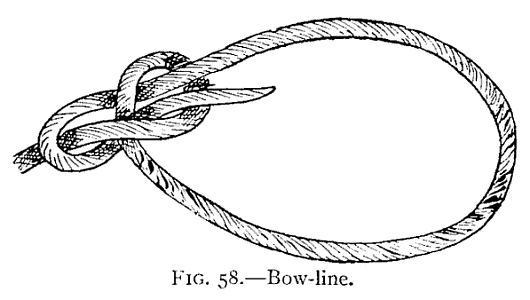
This knot is used with single piece strings on Asiatic composite bows. The drawing is roughly based on the one in Saracen Archery. I have tried this knot and it works efficiently. In my experiments, I served the whole of the end of the string where the knot is tied. This increases the friction in the knot.
The loop is adjustable and the string length can be altered. I was present when Dr Grayson used this knot on a gut string he had made for a Turkish flight bow. The string knot never pulled loose or elongated.
Bow String Knot
-
Bede

- Posts: 2360
- Joined: Mon Mar 14, 2005 11:57 am
- Location: Sydney, Australia
Bow String Knot
You do not have the required permissions to view the files attached to this post.
Bede
-
Ashbow
- Posts: 224
- Joined: Tue Apr 22, 2008 4:17 pm
- Location: Poland
Bede (and others),
I need to make some new bowstring(s) for my Grozer Hungarian base model, I'm using Dacron B 50. So far I have used modern, original Grozer and self-made, endless strings for the bow. Now I consider trying a bowstring with knotted loops, the main reason is I wouldn't need to bother with a string jig and could adjust the string lenght if that would be initially wrong.
Do you think if using the above knot, or the tundj, as shown in Payne-Gallwey's 'Treatise on Turkish Bows', and as well in Klopsteg would do any good when using with my Hungarian bow with non-contact ears? (I know it perhaps won't be traditional.)
Or perhaps there are some more appropriate knots to be used here (I don't want to change the size of the loops I'm using so far.)?
I'm courious what is your experience in that matter, I've also seen Andrew Hall used knotted bowstrings on his MB and Omnogovi bow replicas.
I would appreciate any feedback.
-
osmiu

- Posts: 82
- Joined: Wed Dec 31, 2008 2:30 am
- Location: Romania
the one and only knot that don't fail on me on knotted loops of strings made of fastflight at 85-90 lbl is this knot :
http://www.youtube.com/watch?v=ocpKLPX1tnU
http://www.youtube.com/watch?v=ocpKLPX1tnU
The bravery is not absence of fear , but the power to master it
-
Ashbow
- Posts: 224
- Joined: Tue Apr 22, 2008 4:17 pm
- Location: Poland
-
osmiu
- Posts: 82
- Joined: Wed Dec 31, 2008 2:30 am
- Location: Romania
-
Ashbow
- Posts: 224
- Joined: Tue Apr 22, 2008 4:17 pm
- Location: Poland
You are very right...
That is why I would consider serving the string in the area of the knot before making the knot itself (I think I would like to make the string and loops from one piece, like on the picture above).
From the same reason I don't like to use the timber hitch with a Dacron longbow string, too slippery to keep the bracing height as consisten as I want. I have no experience with fast-flight, but have read that it's even more slippery than B 50?
-
Bede
- Posts: 2360
- Joined: Mon Mar 14, 2005 11:57 am
- Location: Sydney, Australia
Serving the ends of the string is the best way to stop the material slipperiness from being a problem.
The string I made with the integral knot was made from three strand sheep gut. Gut is not slippery when dry and take a knot very well. Untying them after some use can be a major job though since they become very hard.
More relevant to your Dacron question, I have just made a silk Turkish style string with filament silk for the centre section and for the tunc. I made the tunc in the Chinese fashion by completely serving the end pieces. I had tried impregnating with wax and twisting tunc, but the wax made the knot too slippery. The serving made the knot firm and precise. Silk is much more slippery than Dacron. Even the centre serving was capable of moving around.
Making a string with tunc for a contact siyah bow requires just as much precision as any endless loop string, perhaps more. Using that kind of string for a non-contact siyah bow is inefficient (too much extra weight), unhistorical (there is no evidence for tunc before the development of contact siyahs) and inelegant (it looks clunky).
Bede
-
Ashbow
- Posts: 224
- Joined: Tue Apr 22, 2008 4:17 pm
- Location: Poland
Thank you Bede,
I was rather going for the one-piece string. I was worried about the excesive string weight too, so you say I better stay away from those knots .
BTW I remember there is some evidence on using shorter loops on non-contact ears than are common today?
Just one question about your sinew string, you did the serving before tying the tunc, or you served the whole area of the knot afterward?
I was rather going for the one-piece string. I was worried about the excesive string weight too, so you say I better stay away from those knots
.BTW I remember there is some evidence on using shorter loops on non-contact ears than are common today?
Just one question about your sinew string, you did the serving before tying the tunc, or you served the whole area of the knot afterward?
-
fusizoli
- Posts: 186
- Joined: Wed Nov 18, 2009 5:48 pm
- Location: Hungary
-
Bede
- Posts: 2360
- Joined: Mon Mar 14, 2005 11:57 am
- Location: Sydney, Australia
Zoltan,
That is an interesting comment because in the book, Arab Archery, the translators remark that the old sailors they approached including some who had sailed on tall ships did not recognise the knot. I will have to look up the "admiral's knot" and see if there is some minor difference that these sailors thought was more important than we would.
For Ashbow:
The string was silk and I did not use sinew tunj because I made them in the Chinese fashion with silk loops. I made the loops to size and then served them from end to end. The core of the string had small served loops at the ends which I tied the knots through.
Most, if not all, surviving strings for non-contact siyah bows had small loop knots. They were usually just big enough to slip over the end of the bow. The early Hungarian archaeological articles on excavated bows compared them to contemporary (to the archaeologists) Manchu bows. Since they were working with only the remaining bone plates from the bows, they reconstructed the strings from the only thing they had at hand for comparison, the Chinese bowstring. This was a reasonable hypothesis until strings for similar bows were discovered in Central Asia.
Bede
-
fusizoli
- Posts: 186
- Joined: Wed Nov 18, 2009 5:48 pm
- Location: Hungary
Is this drawing shure right? There is a very little different, yours is more complicated but my is working at the same logic, after holliday will make some pics from admiral knot if U not find it on this name. I made my licence here in Hungary may the name is not international (?)
Last edited by fusizoli on Wed Dec 23, 2009 1:33 pm, edited 1 time in total.
Zoltan
-
fusizoli
- Posts: 186
- Joined: Wed Nov 18, 2009 5:48 pm
- Location: Hungary
-
Redhorse

- Posts: 330
- Joined: Sun Sep 03, 2006 8:06 am
- Location: Sweden
-
osmiu
- Posts: 82
- Joined: Wed Dec 31, 2008 2:30 am
- Location: Romania
Every rope has a "breaking strength," which means that if we place a heavy enough load on a rope then it will eventually break . All knots reduce the breaking strength of a rope . BowLine , the knot that enrage Redhorse , reduce the strenght of rope with 40% . In adition to that , is not considerate to be a "secure" knot . And , at least to me , is not the same knot with the one presented by Bede .
If you are looking for a really good knot , use Zeppelin .
(this post is a kind of "all purpose knots" not a particular case of "knots to be used on bow-strings")
If you are looking for a really good knot , use Zeppelin .
(this post is a kind of "all purpose knots" not a particular case of "knots to be used on bow-strings")
The bravery is not absence of fear , but the power to master it