I really doubt it is a tiger bone whistle. The bone peice looks as though it was made of a solid chunk of bone that was later hollowed out to make the whistle cavity.
Having handled a lot of bone, the only bones that I have ever seen that are solid bone all the way through are peices of antler at the base and the ends of antler tines. Other solid bones could include walrus tusks, as mentioned elsewhere here, elephant ivory, and other tusks.
All other bones, even large thick ones have the sponge like matrix of bone inside of them. Only the outer surface of bones are actually solid. The inner matrix is a mix of sponge like bone fibers and marrow.
For these reasons I would suggest that it is some sort of antler or tusk. I'm leaning towards a peice of antler near the base of the skull. Walrus tusk seems unlikely when an abundance of deer, cariboo, elk and moose antler could be easily had.
Tigers don't have any bones that are solid bone through and through.
Identifying materials on an old whistling arrow
-
Hermitking
- Posts: 47
- Joined: Thu Jan 14, 2010 4:16 am
- Location: Nenana, Alaska
-
Bede

- Posts: 2360
- Joined: Mon Mar 14, 2005 11:57 am
- Location: Sydney, Australia
Walrus ivory was used by the Mongols to make arrow heads for sur shooting in the 1920s. There are two in the Grayson Collection. It is heavy and strong. I have thumb ring made from it. In larger pieces, like a thumb ring or an arrowhead you can see the distinctive dentine pattern of the inner part of the tooth.
The femoral bones of some large ruminants like water buffalo have a great thickness of dense bone as opposed to the spongy inner bone structure.
The femoral bones of some large ruminants like water buffalo have a great thickness of dense bone as opposed to the spongy inner bone structure.
Bede
-
Peter Dekker
- Site Admin
- Posts: 171
- Joined: Sun Oct 01, 2006 11:21 pm
- Location: the Netherlands
- Contact:
Thanks for the extra input.
Walrus ivory was also suggested to me by Jack Farrell, but he added that it was always hard to judge a material without handling it.
I've looked up some walrus ivory pics and found it close, but not a good match. Like elephant ivory, it has clear lines but where elephants have two sets of lines crossing each other, (known as Schreger lines) walrus seems to have only one set of similar lines going a single direction. Where one sees the cross-section of the lines, they appear as dots. While some aspects of the material do resemble those of ivory, none of these lines can be found on the whistle head.
Here an example of walrus ivory, from an external website, note the lines going along its length. (Click to view, it is a rather large image.)
http://www.stanscarvings.com/animals/walrus.jpg
Here some classy poker chips, from another website, clearly showing the Schreger lines so characteristic of elephant ivory:
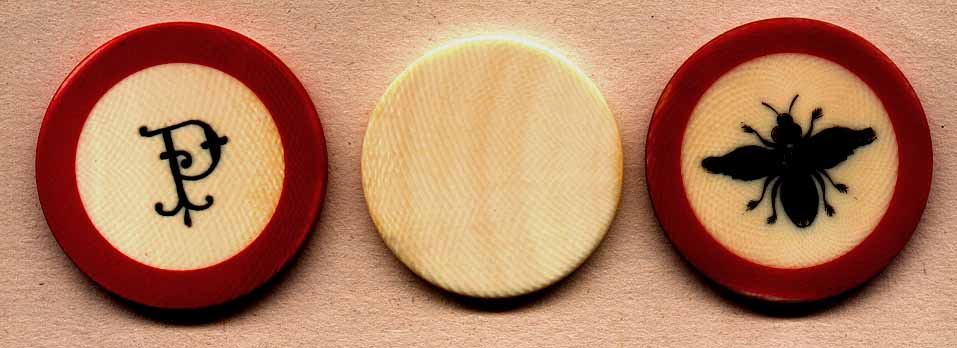
(Usually they're not as prominent as this but they're always there.)
Now another look at the whistle head, I made some pictures that clearly show the holes of blood vessels that go through it:


Because of these, I'm still inclined to think we are looking at some type of bone. Only what type, and from what part of an animal remains in question.
As for antler, would it also exhibit such small channels running through the material?
-Peter
Walrus ivory was also suggested to me by Jack Farrell, but he added that it was always hard to judge a material without handling it.
I've looked up some walrus ivory pics and found it close, but not a good match. Like elephant ivory, it has clear lines but where elephants have two sets of lines crossing each other, (known as Schreger lines) walrus seems to have only one set of similar lines going a single direction. Where one sees the cross-section of the lines, they appear as dots. While some aspects of the material do resemble those of ivory, none of these lines can be found on the whistle head.
Here an example of walrus ivory, from an external website, note the lines going along its length. (Click to view, it is a rather large image.)
http://www.stanscarvings.com/animals/walrus.jpg

Here some classy poker chips, from another website, clearly showing the Schreger lines so characteristic of elephant ivory:
(Usually they're not as prominent as this but they're always there.)
Now another look at the whistle head, I made some pictures that clearly show the holes of blood vessels that go through it:
Because of these, I'm still inclined to think we are looking at some type of bone. Only what type, and from what part of an animal remains in question.
As for antler, would it also exhibit such small channels running through the material?
-Peter
-
jack farrell
- Posts: 1864
- Joined: Sun Mar 13, 2005 3:40 am
- Location: Texas
Peter; This material is DEFINITELY NOT walrus ivory.
I would think that horn-like material would be much more suited to the purpose. Whatever it is it was shot only at a very soft, safe target.
The surface looks rough like the grain is raised.
It has been assembled on a center seam?
The grain has been arranged so that impact further compresses the layers of material.
-
Peter Dekker
- Site Admin
- Posts: 171
- Joined: Sun Oct 01, 2006 11:21 pm
- Location: the Netherlands
- Contact:
I figured that these additional pics would clear it up. My previous pics concentrated on the finer sides of the arrow, that didn't show the holes.Jack Farrell wrote:Peter; This material is DEFINITELY NOT walrus ivory.
Yes it is described in an 18th century text on the emperor's toys to be shot at a felt target made of concentric rings, exactly like the one Stephen Selby encountered when visiting the Xibe tribe. The trick was not only to hit it dead center, but also to hit it with an arrow going perfectly straight for the tail not to hit the other rings. It is conceivable that the whistling sound also contributed to the appreciation of the correct flight of the arrow. Behind the target would be a net or a soft "screen" of cloth to catch the arrow. I too expect the head to shatter when hitting something harder. A friend in the U.S. has two quite similar arrows, also both made of a similar material. Both have broken heads and were glued together again.Jack Farrell wrote:I would think that horn-like material would be much more suited to the purpose. Whatever it is it was shot only at a very soft, safe target.
It is a one-piece construction, no seams to be seen. I have no idea how they did that.Jack Farrell wrote:It has been assembled on a center seam?
Thanks, that's a detail I missed! Aligning it the other way and the shaft might have indeed split it on impact.Jack Farrell wrote:The grain has been arranged so that impact further compresses the layers of material.
-Peter