
Jack,
I don't follow you. The bows preserved in Xinjiang are mostly from shallower graves, which were associated with poorer people, but their presence is assumed in in richer burials. The deeper burials resulted in the destruction of organic material due to the increased moisture in the deeper layers of the soil.
There are some bows in Scythian burials in the west though they are fragmentary. There were probably bows in the Pazyryk tombs too, but like the Royal Scythian burials they were robbed in antiquity. There are some Scythian style tombs that have been found intact in Central Asia. The body was buried with full equipment, including gorytos, bow arrows and sword. Gold hats (maybe crowns) were also found.
Most Western Scythian gold and electrum gorytos covers probably were still attached to the gorytos when they were buried. Often they were found with piles of bronze arrow heads.
I agree that armour was used by the Scythians. The Metropolitan Museum of Art acquired a nice leather scale corselet and archaeologists have excavated many man and horse armours in Scythian tombs. They would have provided some protection from light western Scythian arrows at long and medium range, but up close there were targets that could be reached.
I think that the Xinjiang equipment is a later development to shoot heavier arrows more effectively. As I wrote before, there is pictorial evidence that longer draws were also used in the West with larger Scythian bows. This probably happened because the tribes themselves started to wear more armour as they became richer. The Pazyryk tombs represent an intermediate period. The arrows found there were reconstructed at about 80 cm long. By the time the Dahae tribes founded the Parthian kingdom in Iran, the large bow and gorytos were normal in Central Asia.
I am not sure that Herodotos' story is relevant. The boy was anointed as Heracles's son because he could lift the rock and string the bow; signs of strength and skill. I am sure that no Scythian king had only one bow.
It was the Huns who liked giving their Germanic allies non-functional gold covered bows. It is true that both the Parthians and Scythians depicted the king holding a bow on their coins, but it a long way from that to say that they would forfeit their kingship by burying a bow in the tomb.
Yanghai (Scythian) bow weight tested
-
jack farrell
- Posts: 1864
- Joined: Sun Mar 13, 2005 3:40 am
- Location: Texas
Bede; My thesis is that Eastern Scythian bows and arrows were larger in general than their Western equivalents, and the sources of the finds differ by the richness of the graves. But we may assume that this represented archery traditions not divided by social class.
I do not recall any image of a Scythian king wearing a crown. Davis-Kimball refutes that gold headgear belonged to males. By the time this became well published, the authors had too much invested to retract. This is female headgear found in warrior women tombs.
Herodotus' story is more than relevant it is archetypal. Allowing sons to compete for the throne was the major factor ending the Mongol Empire ninteen centuries later, Morris Rossabi.
I believe that it was Rudenko who pointed out that Russians excavated 2000 kurgan burials without finding a bow; gorytus, yes, arrows, arrowpoints, yes; bow, no. The bow represented the authority of the father.
-
Stephen Selby

- Posts: 1452
- Joined: Thu Mar 10, 2005 1:10 pm
- Location: Hong Kong
- Contact:
Ada: nice to see these first pics of the competed project.
How do you reckon these bows were gripped? That has always been the biggest mystery for me.
Jack, Bede. The Yanghai burials were on a dried inland sea bed where deep digging encounters a pebble layer. Probably none of the burials was very deep, regardless of the class of the grave-owner.
How do you reckon these bows were gripped? That has always been the biggest mystery for me.
Jack, Bede. The Yanghai burials were on a dried inland sea bed where deep digging encounters a pebble layer. Probably none of the burials was very deep, regardless of the class of the grave-owner.
-
jack farrell
- Posts: 1864
- Joined: Sun Mar 13, 2005 3:40 am
- Location: Texas
Stephen and all; I found two illustrations. One Scythian bronze from Kazakhstan appears to show a rider gripping below the central reflex with the small limb up. (Of Gold and Grass, p 125)
Another of Greek workmanship shows two Thracians with Scythian bows doing the same (From the Land of the Scythians, plate 80). Copyright considerations make it inadvisable to post here. I did publish the Thracians in the proceedings of WTAF 2009 for those with a copy. This complied with Korean provisions.
My interpretation will have some controversy because of the quality of the works and the photography.
There are few Scythian works showing an archer drawing a bow.
-
Bede

- Posts: 2360
- Joined: Mon Mar 14, 2005 11:57 am
- Location: Sydney, Australia
Jack,
I agree with the idea that the larger bows were a Central Asian development in the Scythian pattern. What I was suggesting is that it moved west fairly quickly because the evidence of the depiction of bows in Attic pottery.
The nature of the graves probably is more related to preservation and chance discovery. Different conditions preserve materials differently. S. I. Rudenko died in 1969. At that stage very few intact bows had been found anywhere outside of Egypt. He was most disappointed at Pazyryk because of the absence of bows. But all the tombs he investigated were previously robbed. That was the method by which water entered the burial chamber and froze thus preserving the bodies.
Regarding crowns, perhaps I was imprecise. Royal head coverings for men among the Scythians appear to be just a form of their normal hats. Davis-Kimball provided some very interesting information on female burials, particular of archers. The headgear that was originally called a crown by archaeologists in the "Golden Man" burial looks like it was just a richer version of special female headdresses.
Most steppe peoples who formed large states had issues with inheritance, not just the Mongols. Primogeniture was unknown. The most likely successor was the next eldest brother of the same generation. Chinggis Khan apparently nominated his third son, ?gedei, while he was still alive, but by the time of M?ngke the Khanate was transferred to Khubilai his brother on his death. Despite agreeing with you about that, I cannot see how something that is possibly archetypical about success in inheritance is relevant to burying bows with kings.
When I first became interested in these bows, there was little information except the Soviet excavations. When I read Rudenko's book on Pazyryk, the first thing I looked for was evidence of bows. It was unfortunate that they didn't survive. It seemed that anything near the bodies was stolen if it could be taken out of the tomb. The arrows were apparently broken to retrieve the bronze arrowheads. I spoke many years ago with another archaeologist who was working on frozen tombs and he said that they had found some bows since Rudenko's time. Perhaps it was a mistake in translation.
Bede
-
Daniel T.
- Posts: 218
- Joined: Mon Jun 29, 2009 1:08 pm
- Location: Austria
I have seen such a depiction, too. I do not have a picture because it was not allowed to take pictures. The exhibition was called "Das Gold der Steppe". I can't find the notes I took, but I am pretty sure that the piece I saw was from the Ukraine Museum of National History (or similar).jack farrell wrote:Stephen and all; I found two illustrations. One Scythian bronze from Kazakhstan appears to show a rider gripping below the central reflex with the small limb up. (Of Gold and Grass, p 125)
-
Adam Karpowicz
- Posts: 753
- Joined: Sun Mar 13, 2005 11:57 am
- Location: Canada
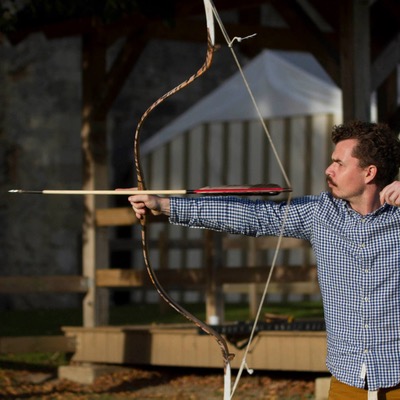
I have tried to draw the bow by hand a few times (nowhere near the full draw!) and the apex of the grip reflex is without a doubt the natural place to hold the bow. I will try again, but I am quite certain the gripping above or below will be very uncomfortable. Perhaps the leather wrapping on one of the Yanghai bows above the grip curve is the arrow pass?
Adam
Adam
-
jack farrell
- Posts: 1864
- Joined: Sun Mar 13, 2005 3:40 am
- Location: Texas
-
Bede
- Posts: 2360
- Joined: Mon Mar 14, 2005 11:57 am
- Location: Sydney, Australia
Adam and Jack must be right. Why would you put all that setback in if you were not going to take advantage of it? The most popular composite bow prior to the Scythian was the angular composite, which was used on foot, in chariots and on horseback. Why go to all the trouble of adding all those curves if you did not make use of them? One of the things that will be testable with the building of these bows is the performance compared with the older angular bows. Maybe we will see an advantage.
Bede
-
Peter Dekker
- Site Admin
- Posts: 171
- Joined: Sun Oct 01, 2006 11:21 pm
- Location: the Netherlands
- Contact:
An odd bow it is!
It does indeed seem illogical to grip it anywhere but the setback grip.
As for artwork depicting Scythians gripping the bow below the center, I wonder could have been made by artists who were unaware of how these bows were gripped? Most people think the arrow goes in the center of a bow, so it has to be gripped below that. In my introductory lessons I see first-timers grip Asian style bows below the handle all the time.
Perhaps one artist started this misconception and others just copied it until it became a widespread notion.
-Peter
-
jsachers
- Posts: 58
- Joined: Tue May 29, 2007 7:29 pm
- Location: Germany
- Contact:
Is that what we're talking about?
http://de.academic.ru/pictures/dewiki/68/Darius_III.jpg
I've got a nice picture of the Subeixi bow copied into that illustration (the so called "Alexander Mosaic) in exactly the same size and position. Unfortunately I can't post it here due to copyright restrictions.
http://de.academic.ru/pictures/dewiki/68/Darius_III.jpg

I've got a nice picture of the Subeixi bow copied into that illustration (the so called "Alexander Mosaic) in exactly the same size and position. Unfortunately I can't post it here due to copyright restrictions.
-
jack farrell
- Posts: 1864
- Joined: Sun Mar 13, 2005 3:40 am
- Location: Texas
Jan; This is exactly what I mean. You can see that the sharp bend is above his hand and the gentle bend (the long limb) would be below. He grips below the apex of the reflex.
What I was looking for was a Scythian depicting a Scythian drawing a bow. The Kazakh bronze is just such a depiction.
Peter; Ancient artwork should be taken for what it is. We are just now discovering what a real Scythian (and other) bows really are. It would seem a bit condescending to say that they do not know how they were used. What use would we have for an image of someone shooting a gun upsidedown?
Because of the argument that a Greek is not so well versed in archery as they were in goldwork, the most authoratative depiction would be contemporary Scythian works.
-
redhawk
- Posts: 618
- Joined: Sun Mar 20, 2005 9:45 pm
- Location: GERMANY,Schopfheim
- Contact:
R. Toelle- Kastenbein has published the book "Arrows and Bows in the Greek Antique".
This is the best collecion of pics and paintings focused on Greek archery, with almost every pic we know about Scythian bows.
Scythian bows are hold below the center, the arrow is shot from the center. The longer smaller limb is up.
Bede is very right, asking for the sense of the set- backed grip.
E. Godehardt and me tested our Scythian reconstructions, while shooting arrows from the center or above the apex..
Speed is higher when a Scythian bow is apex- shot.
Michael
-
jack farrell
- Posts: 1864
- Joined: Sun Mar 13, 2005 3:40 am
- Location: Texas
-
Hermitking
- Posts: 47
- Joined: Thu Jan 14, 2010 4:16 am
- Location: Nenana, Alaska
The mosaic of Alexander going after Darius does seem to depict a Sythian-like bow. The only problem I have with that is that Darius was a Persian, and the bow is not of a Persian design.
Thus it seems to me that the artist took some artistic liberties when depicting the bow. I suspect the artist was unfamiliar with the exact design of a classic Persian bow, but was very familiar with the common Greek bow, which is very similar to the Sythian bow. He inserted a bow according to his particular experience with bows.
Concerning how one grips such a bow, I suspect the arrow was placed dead center on the apex of the reflexed handle. The thumb and first two fingers lightly gripped the handle below this point and the remaining fingers very lightly touched the lower portions of the grip. This sort of bow would buck and squirm in the hand and a light grip would produce better shooting, at least from my experience with highly reflexed grips.
If one held the grip any lower the angle of the wrist would become uncomfortable if not painful at full draw.