
Cem, thanks - the drying after last sinew layer was no more than 1 month before I pulled the bow on the scale. I did not worry about the loss of cast in this bow, and rather liked the string follow for safety.
The bow stable and the limbs do not have the tendency to twist, despite the odd construction (narrow limbs). The sinew wrapping helps to resist the torque.
Adam
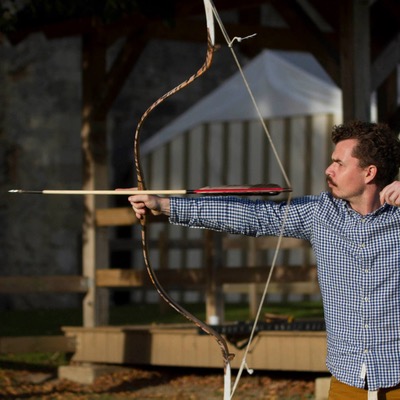
Yanghai (Scythian) bow drawn pictures
-
Adam Karpowicz
- Posts: 753
- Joined: Sun Mar 13, 2005 11:57 am
- Location: Canada
-
Stephen Selby

- Posts: 1452
- Joined: Thu Mar 10, 2005 1:10 pm
- Location: Hong Kong
- Contact:
-
M??a
- Posts: 69
- Joined: Tue Jul 01, 2008 9:43 pm
- Location: Prague
 You are master. I?m looking for shooting quality
-
Adam Karpowicz
- Posts: 753
- Joined: Sun Mar 13, 2005 11:57 am
- Location: Canada
-
Redhorse

- Posts: 330
- Joined: Sun Sep 03, 2006 8:06 am
- Location: Sweden
Adam Karpowicz wrote: the drying after last sinew layer was no more than 1 month before I pulled the bow on the scale.
Adam
 can't help, this sounds so familiarly.
Made any f-d yet?
When I brace a turk bow I have almost same weight in limbs at brace as the full draw. From reflex to brace is many inch draw. With deflex you should have less weight, and few inch draw, can you make a measure of that?
Its not easy brace a 100 lb reflex bow behind leg.
-
osmiu

- Posts: 82
- Joined: Wed Dec 31, 2008 2:30 am
- Location: Romania
-
jiao

- Posts: 663
- Joined: Fri May 06, 2005 1:24 pm
- Location: china
- Contact:


-
Peter Dekker
- Site Admin
- Posts: 171
- Joined: Sun Oct 01, 2006 11:21 pm
- Location: the Netherlands
- Contact:
Great work!
Really nice to see that your replica looks exactly as cartoon-ish as on the ones depicted on period artwork depicting them. It is almost a caricature of a composite bow as we know it from later times. I find it very interesting to see that such an extreme form is so old.
Do you have any ideas as to why these were made the way they were? It seems like a lot of work, and the way the horn goes through them seems counterproductive. (Although bowyers that made similar constructions like Jaap say that it works fine.)
It would be great to see how a design like this compares to traditional Turkish and Korean bows but I get your point in how little representative a first try potentially is in that regard.
EDIT: BTW, as for the tips: I think they might be produced like this because this construction seems really strong: A curling tip like this would be very well protected against shearing and thus could potentially be constructed lighter than a less curling tip that needs to deal with the same draw weight. It is not only the way the stress is put on the very tip, but also the friction caused by the string still rubbing the ear in the last stages of the draw that probably relieves stresses off the very tip.
-Peter
-
Stephen Selby
- Posts: 1452
- Joined: Thu Mar 10, 2005 1:10 pm
- Location: Hong Kong
- Contact:
I had a lot of discussions with archaeologists from a number of countries when introducing Adam's reconstruction of the Saka bow in Xi'an. A particular related point coming from experts in historical bronze casting in Asia is that communities adhered to formulae that were not the best technology available while it was clear that they were aware of better technologies around them.
I also had the chance to examine horn bows from a horizon earlier than the Saka bows from Shanshan. (i.e. the Scythian design was current between around 800 - 200BCE, while the earlier horizon bows are thought to represent the same community from 1000 - 800BCE). The earlier bows had some degree of sinuous curve like the Saka bows but were made of wood/horn/sinew in a much more 'conventional' manner (from our present standpoint). That is, a horn belly, wood core and sinew backing with sinew winding.
I have gained a very string impression that the Saka interest in the predominantly horn bow with extravagant curves was more connected to their totemic use of the mountain ibex than to an objective desire for technological excellence.
-
redhawk
- Posts: 618
- Joined: Sun Mar 20, 2005 9:45 pm
- Location: GERMANY,Schopfheim
- Contact:
Stephen thanks for this report.
That?s the point: every type of bow is not only done according to the knowledge of the best avaible technology, it is also done according to actually dominating cultural conditions, like the totemic use of the ibex f.e.
Interesting to hear, that the forerunners of the Saka- bows were made in the usual hornbow- way. Pics? What kind of horn?
Was the olon kurin gol bow mentioned somehow?
Michael
-
redhawk
- Posts: 618
- Joined: Sun Mar 20, 2005 9:45 pm
- Location: GERMANY,Schopfheim
- Contact:
-
Stephen Selby
- Posts: 1452
- Joined: Thu Mar 10, 2005 1:10 pm
- Location: Hong Kong
- Contact:
Yes, assymetrical.redhawk wrote:I want to add my usual question: are these "earlier bows" asymmetrical? Michael
As to your second point, the location of excavation was the same as the 'saka' bows - Yanghai - ; but they didn't actually have 'Made in Scythia' stamped on them
Without further evidence, there could be an argument that they belonged to an earlier non-Saka culture. Unfortunately I never had a chance to excavate them in situ and the excavation report has not been prepared. Because these finds are 'un-exciting' to archaeologists, it may be some time before they are written up. But I'll make more inquiries.S