
Korean target hornbows have a single core lath with spliced in ears and a grip overlaid onto the back side of the core lath. My assumption is that the earlier war bows would have been constructed on the same model.
I believe that Adam stated earlier that a Turkish Tatar bow had that same construction.
The only angle which is permanent is the bend at the ear. Since both bows have all the same parts, one might assume that they had a similar origin.
Thanks Bede and Dusan for the sources. -j-
comparative anatomy
-
jack farrell
- Posts: 1864
- Joined: Sun Mar 13, 2005 3:40 am
- Location: Texas
-
Bede

- Posts: 2360
- Joined: Mon Mar 14, 2005 11:57 am
- Location: Sydney, Australia
Jack,
Applying the handle riser to the back of the limb is noted on Persian bows based on the dissected one at the beginning of Turkish Archery and the Composite Bow. The diagram is attributed to Balfour. The Ming encyclopaedia also refers to a single piece of bamboo as the centre of the bow making up the handle and the bending sections. The book describes the bamboo strip as being about two ch'ih (61.2 cm in the Ming Dynasty where the ch'ih was 31.1 cm) long and narrower in the middle than the two ends. The siyahs are made from mulberry wood spliced into the bamboo. It is not specified in the text whether the length of the bamboo strip is its total length or the length to the beginning of the splice. The profiles of the Ming bows in paintings imply the handles have a riser on the back side.
To clarify the measurements, Stephen may offer some comments. In books of this time it was not uncommon to mention a measurement that in reality is part of an unacknowledged quotation so the ch'ih might have had a different length. Considering most ch'ih from previous dynasties were shorter, the quoted equivalent is more likely.
Getting back to bows with applied risers, the Qing bows had them too so we can split up bows into two groups: spliced handles including the Turkish bows and some Indian composites like the Sind bow; applied risers like the Korean, Qing, Ming, Persian and Crimean Tatar.
I think the crab bows had applied risers too, but I will check on that.
Bede
-
Dusan
- Posts: 990
- Joined: Sat Jun 30, 2007 6:29 pm
- Location: Slovakia
I havnt nothing against your history teory abot Manchu/ Ming influences. I look in bows more from bowmaker practis position . From this reason i think that kasan rigid bows was evolution oldest tip of war and hunting bows. Rigid kasan give stronger faster bow . When bows lost his war and hunting sense , lost his kasans, because longer flexible bending section is less problem for bowmaker and give longer fluent draw for target archer.
This small pics is maximum what i found in net. Maybe sombody who was close to the Koreans museums can make better pics. I hope Bede, when you visit next WTAF, you can more interestined about this war bows. Its looks like Koreans "forget" about this variation of bows and prefer todais - modern target disain.
I know this all wood Korean military bows. I admire this master piece of bows. This is chalange for composite bowmaker...
-
Adam Karpowicz
- Posts: 753
- Joined: Sun Mar 13, 2005 11:57 am
- Location: Canada
The side profile and relative stiffness of the sections should not be confused with the construction of the interior core.
Crim-Tatar bow did not have bamboo, but two wooden limbs spliced to the grip (as Turkish). The tips were spliced too, but perhaps not always. The spliced-in grip could be laminated itself.
I have not seen or heard of a Tatar bow with one long piece of wood (to replace bamboo in the Far Eastern construction) for both limbs with the overlayed grip. If the Tatars had bamboo, perhaps they would use it in this way.
The function and perforamnce depends on the side profile and the behaviour of the sections as the bows are bent. The flexibility of the sections is related to the final width and thickness of the components, as well as to the cross-sectional profile. I do not see how a bow with the overlayed grip in the core would fuction differently from a bow with the spliced-in grip, as long as the relative stiffness of the sections is the same in the finished bow. Kasans made rigid, regardless whether triangular or rectanguar, will behave identically when the bow is shot, provided the mass of the parts is similar. This is why I maintain the Korean/Ming bow with rigid siyahs is practically the same bow as the Tatar as far as the cast is concerned. The differences between the two bows will not be greater than the differences within the particular styles, where the size, thicknesses, widths, length of parts varied quite a bit anyway.
Adam
-
jiao

- Posts: 663
- Joined: Fri May 06, 2005 1:24 pm
- Location: china
- Contact:
i see the male do more manly things at spring  let us say all we want to say before 2012

china han dynasty
turkish hornbow by adam Karpowicz

korean


china ming dynasty

see the ming hornbow, it has a kansan but handle differ to turkish, has not any bow in tomb or picture of turks hornbows show the early times turkish bow, maybe there bow same as huns long ear bow, the short ear design main is form chinese but kansan is turks invent, the lose the bell huns and turks make Europe deep dread and hatred to china.....the huns is a embranchment of chinese , so i sound like korean, all of hornbow design inspirational headspring is form chinese!

let us say all we want to say before 2012 china han dynasty
turkish hornbow by adam Karpowicz
korean
china ming dynasty
see the ming hornbow, it has a kansan but handle differ to turkish, has not any bow in tomb or picture of turks hornbows show the early times turkish bow, maybe there bow same as huns long ear bow, the short ear design main is form chinese but kansan is turks invent, the lose the bell huns and turks make Europe deep dread and hatred to china.....the huns is a embranchment of chinese , so i sound like korean, all of hornbow design inspirational headspring is form chinese!
-
jiao
- Posts: 663
- Joined: Fri May 06, 2005 1:24 pm
- Location: china
- Contact:
china tang dynasty praetorian hornbow in a tiger hide quivers

the longer hornbow tang dynasty


the long ears hornbow of tang dynasty

tang dynasty crab bow?

 [/img]
the longer hornbow tang dynasty
the long ears hornbow of tang dynasty
tang dynasty crab bow?
[/img]
Last edited by jiao on Thu Apr 29, 2010 1:42 pm, edited 1 time in total.
-
Dusan
- Posts: 990
- Joined: Sat Jun 30, 2007 6:29 pm
- Location: Slovakia
-
Bede
- Posts: 2360
- Joined: Mon Mar 14, 2005 11:57 am
- Location: Sydney, Australia
Jiao,
Several early Turkish bows have been excavated from tombs in Mongolia. They date between the 8th and 10th centuries. They have been published in catalogues of exhibitions about Chinggis Khan.
Adam,
I was relying on an earlier reference to your book in this thread and did not look it up again myself. I did remember you mentioning the overlays. Your description of the Tatar bows puts it closer to the Turkish bow in construction.
If you mean by your comment that a rectangular sectioned kasan would behave the same as a triangular one of the same stiffness, I agree, but they would probably have different masses. My point was the the constructional techniques are a better guide to relationships between bows than general form because for is easily copied or can be developed because it is best fit solution to a problem. Constructional techniques tend to be inherited in workshops taught from father to son or master to apprentice. I think that changing the functional design, like stiffening the kasan area, would be easier to achieve than changing how the core was joined together.
Bede
-
Bede
- Posts: 2360
- Joined: Mon Mar 14, 2005 11:57 am
- Location: Sydney, Australia
-
jack farrell
- Posts: 1864
- Joined: Sun Mar 13, 2005 3:40 am
- Location: Texas
This is a small point but I think important nonetheless. The earliest Turkic period bows do not have kasans, that is, the ridged section of the upper limb. Serindia posted two early Turkic type bows
http://atarn.net/phpBB2/viewtopic.php?t ... sc&start=0
neither of which has a kasan. The Shiluustei sum bow of the 13th century from Mongolia lacks a kasan, as do the contemporary Mongol Empire bows of Hunnic developed types. Late bows lacking kasans are not regressions on Turkic styles, these are bows which failed to assimilate this later design feature. One possible explaination could be a desire to make the bow more tolerant of extreme weather conditions in which a Turkish type bow would be vulnerable to breakage. Qing, Buryat, North India crab, Hunza and other bows do not have kasans but are contemporary to Turkic construction.
-
Stephen Selby

- Posts: 1452
- Joined: Thu Mar 10, 2005 1:10 pm
- Location: Hong Kong
- Contact:
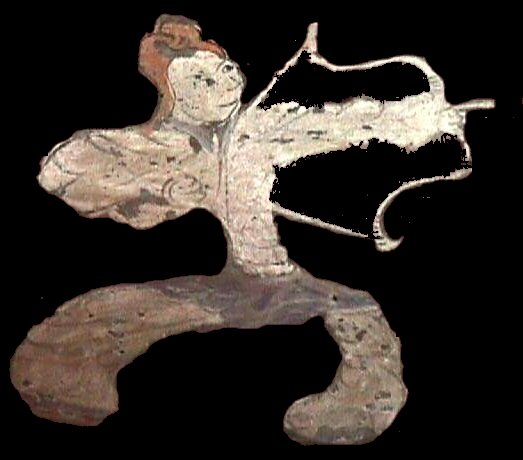
焦:请提供以上照片的进一步资料。 我猜到, 是属于唐代的。 内容是佛教天使克服敌人,把他的弓破掉。 不是上弦吧。
Jiao: can we have more info on this picture? My interpretation: it is a Tang dynasty image of an Apsara (head obliterated in the late Tang anti-Buddhist movement ) breaking the bow of a defeated enemy.
S
-
jiao
- Posts: 663
- Joined: Fri May 06, 2005 1:24 pm
- Location: china
- Contact:
about this picture show string a bow or breaking bow, if bend the bow to front it is a good method?but bend the bow to the back maybe break the long ears and handle
it has no word info about it but maybe i can try ask where find it, i guess these books has lots thread find tang dynasty and earliest Turkic period bows,

it has no word info about it but maybe i can try ask where find it, i guess these books has lots thread find tang dynasty and earliest Turkic period bows,
-
Dusan
- Posts: 990
- Joined: Sat Jun 30, 2007 6:29 pm
- Location: Slovakia
-
Adam Karpowicz
- Posts: 753
- Joined: Sun Mar 13, 2005 11:57 am
- Location: Canada
It depends how one defines kasan. Is it only the ridged section, or all stiff or (semi-stiff) sections below the tips are kasans? If the latter, then most these bows have kasans. The crab bow certainly does (not only rigid, but also triangular).
I think it is a useful word to use for all (semi) rigid, sinew-backed, often horn-bellied sections between the bending parts and the uncovered tips.
Adam
I think it is a useful word to use for all (semi) rigid, sinew-backed, often horn-bellied sections between the bending parts and the uncovered tips.
Adam
-
jack farrell
- Posts: 1864
- Joined: Sun Mar 13, 2005 3:40 am
- Location: Texas