
I've got a long draw, 33". My wooden arrow shafts are all 31~32" finished, which means I'm not able to comfortably go to a full draw and am always stopping short to prevent skewering myself...
I've been looking around for a source of long arrow shafting with not a lot of encouraging results.
Has anyone dealt with a company that supplies bamboo arrow shafts in 33 ~ 34" (or longer) and in the 35~40, 40~45# ranges (spine matched)?
Byron
bamboo arrow shafting
-
Byron
- Posts: 27
- Joined: Tue Apr 20, 2010 1:25 pm
- Location: Toronto
- Contact:
-
Justin Ma

- Posts: 309
- Joined: Fri Feb 05, 2010 6:00 am
- Location: Bay Area, California, USA
- Contact:
Have you tried the bamboo shafting from 3Rivers?
http://www.3riversarchery.com/Primitive ... oduct.html
It doesn't say anything about spine and it is kind of expensive. But it looks to be long enough at 33".
http://www.3riversarchery.com/Primitive ... oduct.html
It doesn't say anything about spine and it is kind of expensive. But it looks to be long enough at 33".
-
jack farrell
- Posts: 1864
- Joined: Sun Mar 13, 2005 3:40 am
- Location: Texas
I buy bamboo shafts in the gardening department of the Home Depot store.
You have no idea how difficult it is to match a group of shafts. Species vary; quality varies; but price is low.
Providing these for commerce could be the worst idea going.
A first class set of bamboo arrows is really sublime to shoot though.
Last I looked there was a man in China who was matching Tonkin cane for arrow purposes. Google Tonkin cane. I do not know about feedback on him.
Jap Koppedrayer wanted to raise and sell P. japonica. He does not match his old stock, beware.
There are great expanses of the stuff in New Orleans, Louisanna.
Three Rivers does not match shafts. Pity, with some work the price could be tripled.
Used Korean arrows sell well at WTAF, if you get there first. A known arrow smith declared some of them as fit.
New Korean arrows sell for about 40 USD each, Japanese 200-300 USD each . Bhutanese sb less than Korean.
-
Bede

- Posts: 2360
- Joined: Mon Mar 14, 2005 11:57 am
- Location: Sydney, Australia
Have you tried footing standard wooden shafts? In the old days this was used to make arrows with the fore shaft tougher. A piece of heavier wood is spliced into the end of the arrow shaft and shaved down to be the same thickness and roundness. This is an old practice used in England, Ancient Egypt (where a hardwood fore shaft was tenoned into a reed arrow), Turkey (where it was even used to repair flight arrows) and China (I have examined a Qing arrow that had a splice under the sinew binding on the fore shaft).
Many years ago I made super long arrows by splicing another piece of the same wood into the end. I have also repaired arrows in the Turkish fashion and have shot them repeatedly afterwards.
There are four standard splicing designs:
Many years ago I made super long arrows by splicing another piece of the same wood into the end. I have also repaired arrows in the Turkish fashion and have shot them repeatedly afterwards.
There are four standard splicing designs:
- 1. Creating a conical tenon usually with a shoulder to fit into a matching hole in the tip of a reed or bamboo arrow. Mark Streeton in England has successfully used this technique with wooden arrows but it required machinery. With reed or bamboo, it is easier. Unlike Native American footed shafts, the footing is the same diameter as the shaft and any sinew binding is flush with the surface.
2. A one pointed footing was used by the Ottoman Turks to repair broken barrelled arrows. This required the two pieces, the arrow and the new fore shaft, to be tapered diagonally with matching angles. The two pieces were glued together, making sure the whole arrow was straight. Dr Grayson showed me how to do this with modern tools very quickly using a belt grinder. I am very careful to orient the splice so that a failure would not end up with a piece of arrow in my hand.
3. A two pointed footing was used by the Turks, the English and the Chinese. The Chinese and English cut a thin slot in the end of the fore shaft and cut the end of the arrow into a wedge. The wedge was covered in glue and forced into the slot. The projecting parts of the fore shaft were removed when the glue set and it was rounded to match the arrow. shaft. The Turks reversed the procedure by inserting the fore shaft wedge into a slot in the arrow. This may have helped planing the arrow down to a barrelled shape. I am not sure that these divisions were always adhered to because it is sometimes difficult to tell with a well made arrow.
4. In England and in North America where English equipment was used, a four point splice was used. Two slots crossing at right angles were cut in the fore shaft. A complicated set of four tapering grooves were cut in the end of the arrow to match the fore shaft. The two pieces were glued together and the shaft was rounded and smoothed. The effect was like expensive old fashioned billiard cues.
Bede
-
KenH

- Posts: 240
- Joined: Sun Nov 08, 2009 12:53 am
- Location: Fort Myers, FL
- Contact:
-
jack farrell
- Posts: 1864
- Joined: Sun Mar 13, 2005 3:40 am
- Location: Texas
-
PjSingh
- Posts: 138
- Joined: Thu Oct 18, 2007 5:11 pm
- Location: ohio
I recently obtained a bundle of 500 tonkin cane from a supplier in florida,these were for garden stakes and are 4 feet long and have obtained about 75 usable shafts from these and have not even gone through the whole bundle yet.The price is right app 60 $ plus shipping,just need a lot of work matching them and straightning them.The ones I have used so far are preforming very well.
pjsingh
-
KenH
- Posts: 240
- Joined: Sun Nov 08, 2009 12:53 am
- Location: Fort Myers, FL
- Contact:
-
jack farrell
- Posts: 1864
- Joined: Sun Mar 13, 2005 3:40 am
- Location: Texas
Here is one objection to buying shafts whose length is precut. You can't do the layout.
Japanese type layout would have the upper node several inches from the nock. Ancient Japanese layout for war arrows would have the nock cut into a node. Korean layout would have the upper node 7 inches below the nock. Mughal arrows are somewhat similar to Korean.
I now cut all my shafts in the Korean/Mughal layout with a 32 inch shaft, Then weigh the shafts and write the weight on the shaft in permanent marker.
In this manner the groups really look like eachother. One cannot do this if the shafts are already cut to length. So long garden sticks are better for this reason.
-
Bede
- Posts: 2360
- Joined: Mon Mar 14, 2005 11:57 am
- Location: Sydney, Australia
-
mongolianarcher
- Posts: 299
- Joined: Thu Jan 22, 2009 12:51 am
- Location: Florida
-
jchocz
- Posts: 67
- Joined: Thu Dec 24, 2009 10:38 pm
- Location: Czech rep.
I bought a 300 shaft in China (45 to 50 #). They are perfect. Definitely recommend. Good quality and price.mongolianarcher wrote:Ive talked to the man in Taijing, China online, he knows what he is talking about, if you finess him, he will sell you a sample pack of less.
Here: [email protected], http://www.bamboo-arrow-shaft.com
Square deal and fast delivery. I ordered them directly, not from E-bay.
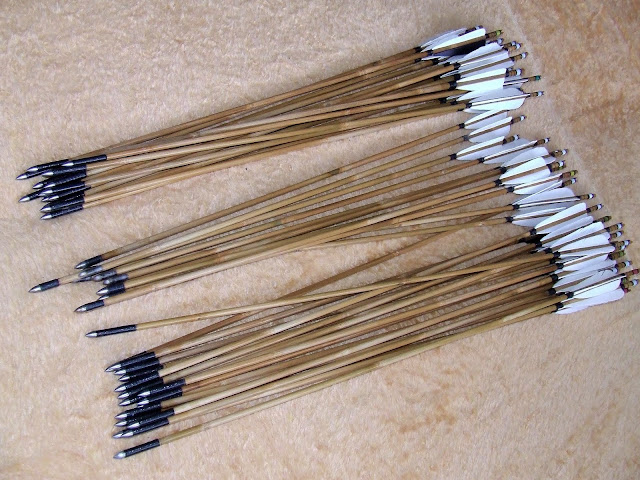
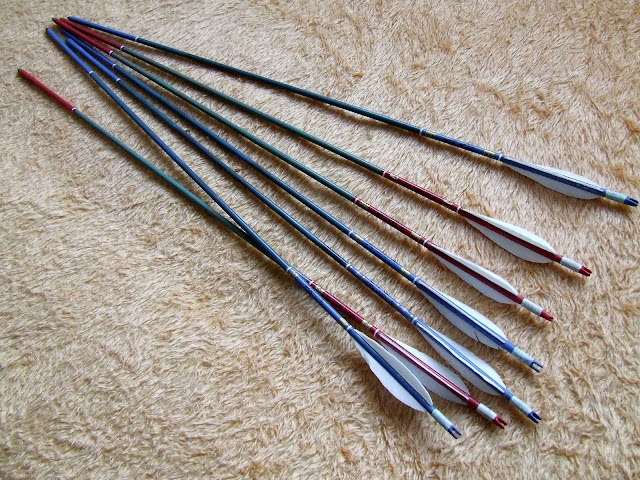
Here are the arrows of bamboo shaft:
-
Jos?Dom

- Posts: 236
- Joined: Fri Jun 06, 2008 3:04 am
- Location: Argentina
I placed an order of 100 bamboo shafts from the same source, Tiger. Now I?m waiting for the order. I?m glad you found them good quality. My only fear is that I think these shafts are dried for 2 months only (according to the website) and I know Japanese let them dry for like 2 years. I wonder if that will be an issue. I got bamboo shafts from Japan before (Asahi and Heisei) and they are perfect service and top quality, but expensive in comparison. The relationship in price comparing China to Japan sources is like 1 to 10.
By the way, the Chinese seller, Tiger, is working on getting horn suitable for bow making. So stay tuned.
By the way, the Chinese seller, Tiger, is working on getting horn suitable for bow making. So stay tuned.
-
Daniel
- Posts: 99
- Joined: Fri Nov 07, 2008 9:19 pm
- Location: Poland/Ireland
Just to add my two cents to what Bede has already said about footing option:
Try "Reparrows" http://www.angelfire.com/biz/Ironwood/Reparrow2.html
Very easy to assemby, holds up very well and you can add up to 3" to arrow length. Sure good bamboo make good arrow, but you need very best material to make light and stiff bamboo arrows otherwise I see no point of going through so much work to get something only close to what very best arrows represent it terms of straightness, profile and very small weight spread.
-
Bede
- Posts: 2360
- Joined: Mon Mar 14, 2005 11:57 am
- Location: Sydney, Australia
Here are some ideas on making bamboo arrows that might help.
As some of you know, wooden nock inserts were usually made with tapers. This increased the area that was glued and made a stronger joint. Jack Farrell has mentioned this also.
If you want stiffer shafts, heating the bamboo until it changes colour while you are straightening them will often work, but too long will wreck them. Some of the stiffest reed shafts I have measured were a dark brown from this treatment.
You can use a dowelling plate (a steel plat with standard sized holes perpendicular to the surface) to remove the nodes and reduce the shafts to a standard diameter.
You can use a router table with a guide to remove a small amount of the skin at the nock and point ends to allow binding that is flush with the surface.
If you are using tanged arrow heads, you can set them in the shaft with tree resin instead of glue. Then you heat the end of the shaft to correct the alignment of the head. For matched sets, weigh the amount of resin.
Bede