
Stephen,
Do you mean they are multiple strands of thin rawhide?
Jack Farrell's Subeixi Bow Reconstruction
-
jack farrell
- Posts: 1864
- Joined: Sun Mar 13, 2005 3:40 am
- Location: Texas
-
Bede

- Posts: 2360
- Joined: Mon Mar 14, 2005 11:57 am
- Location: Sydney, Australia
Jack,
The Middle Eastern way was to cut a strip of rawhide wider than the string, soak it, and then twist it. The resultant cord was pulled through a metal ring to give it a smooth, even surface. The cord was then hung out to dry under tension and prevented from untwisting itself. Once dry it was rubbed with a burnisher to get a smooth finish.
I was going to use a steel dowelling plate instead of a ring. One instruction was to vary the width of the strip of rawhide depending on the thickness of the skin. I have seen one of these from China in good condition on one of the Qianlong Emperor's hunting bows. It looked like a smooth white cylinder with fine diagonal lines showing where the twist was. It was very uniform and about 5 mm in diameter. It was self knotted in the standard fashion.
Bede
-
Stephen Selby

- Posts: 1452
- Joined: Thu Mar 10, 2005 1:10 pm
- Location: Hong Kong
- Contact:
I guess so. Maybe three of four strands, because they are nicely spliced at the loop. I didn't have time to look carefully; but they're nicer than anything I've seen. Anyway, I've ordered some for me and Jack and we'll know soon enough.Bede wrote:Stephen,
Do you mean they are multiple strands of thin rawhide?
S
-
jack farrell
- Posts: 1864
- Joined: Sun Mar 13, 2005 3:40 am
- Location: Texas
-
Stephen Selby
- Posts: 1452
- Joined: Thu Mar 10, 2005 1:10 pm
- Location: Hong Kong
- Contact:
The maker's a good friend; but I don't know how much he'll reveal. He's an industrial-level manufacturer of leather goods so he's probably using some heavy industrial chemicals or equipment in the process. It's not hobby-level.
Incidentally, he'll make archery-related leather goods for people who don't want to make their own. He's invented a rather neat leather keyring tab that doubles as a thumbring (or thumb protector).
Incidentally, he'll make archery-related leather goods for people who don't want to make their own. He's invented a rather neat leather keyring tab that doubles as a thumbring (or thumb protector).
-
JJ

- Posts: 317
- Joined: Mon Dec 08, 2008 9:38 am
- Location: Germany
-
jack farrell
- Posts: 1864
- Joined: Sun Mar 13, 2005 3:40 am
- Location: Texas
JJ; here it is. Most of the illustrations are now deleted. Plan on page 7.
http://atarn.net/phpBB2/viewtopic.php?t ... sc&start=0
http://atarn.net/phpBB2/viewtopic.php?t ... sc&start=0
-
serindia
- Posts: 46
- Joined: Fri May 19, 2006 12:27 am
- Location: Napoli
Ciao, Mr. Farrell, probably, you'd better to try your recontructed "Subeixi" bow with thumb ring or glove ("She" in Chinese. In this character, the left part is "Wei", which means the leather. For instance, the famous story of Confucious - "Wei Bian San Jue". The right part is "Die". Obviously and originally, this ware is made by leather. At present, we proved it by archaeological evidence. What is the Japanese name of "She" - the leather thumb glove?), because archaeologists excavated them from Yanghai Cemetery. As we know that, a part of remains in Yanghai Cemetery belonged to Subeixi Culture.jack farrell wrote:Of course I have begun shooting this bow but with a very short draw. The place where I have gripped feels like a sweet spot, but the main grip lays below this spot. And since I (probably erroneously) made the lower limb similar in dimensions as the upper, and gave it a head start with the extra grip material below, it seems like the upper limb is doing most of the bending.
Since then, I have induced some small amount more bend to the lower limb.
The overall bow is a bit unstable but probably needs more curing. It is also very easy to correct, like a piece of wire. All the parts do bend but mostly in the grip and deflexed part of the limbs.
It will be too strong for me to draw fully. The exhilaration is blissful. Advice?
You do not have the required permissions to view the files attached to this post.
-
Bede
- Posts: 2360
- Joined: Mon Mar 14, 2005 11:57 am
- Location: Sydney, Australia
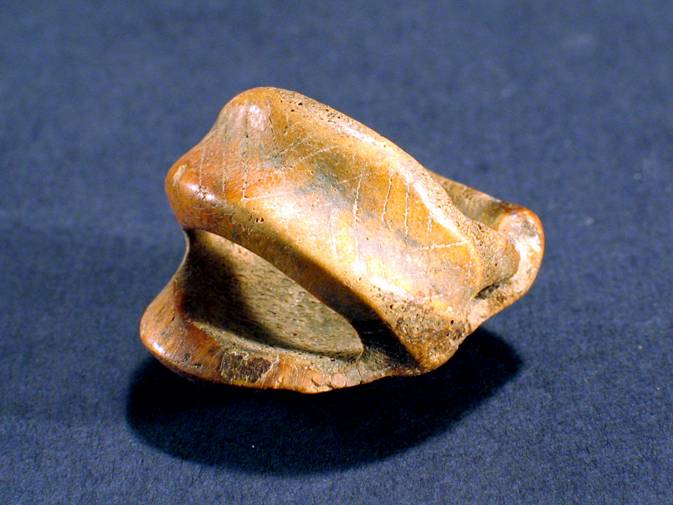
While there is no doubt the Chinese were using thumb rings at this time, I am not sure that what you are illustrating are for shooting with the thumb.
I have seen a bronze version of the bone one you illustrate first. The design was to protect the tip of the digit and the common use now is to force needles into some sort of material. On the bronze one there was no chance to see wear patterns on the surface because of centuries of patina.
The protection of the tip of the digit for archery purposes would indicate a finger stall as were used in South China during the Warring States period. I am not sure of the modern Chinese spelling for the name but it was pan chao in the Wade Giles system. The leather example reminds me of these. It is also similar in construction to the current Bhutanese examples which are made in groups of three. The old pan chao were bamboo in the south I think, but the similar use is clear.
The reason I make these comments is that these objects appear better suited to the protection of the tips of the digit rather than the distal joint, which is the area that the thumb ring sits. If the second one is large enough to cover the thumb, then I suggest that this is a transitional piece where a finger-stall using person has made an attempt to cover the thumb in the same manner. This might be the case where a local archer had decided to shoot like a Han soldier and made his equipment in the local manner.
My comments are speculative. There is other evidence of differing archery techniques. The existence of arm guards in some burials is not of itself a reason to believe that the Mediterranean release was in use locally. They could have been to keep wide sleeves out of the way of the bowstring. However, the garments had narrow sleeves and there is some later evidence of Western archery influence in cave paintings and tomb reliefs. If these object (or one of them) represent a transition between Western and Eastern techniques, this would be a great discovery. We already have Western-style bows (Scythian) represented in the graves.
Bede
-
Stephen Selby
- Posts: 1452
- Joined: Thu Mar 10, 2005 1:10 pm
- Location: Hong Kong
- Contact:
-
redhawk
- Posts: 618
- Joined: Sun Mar 20, 2005 9:45 pm
- Location: GERMANY,Schopfheim
- Contact:
-
serindia
- Posts: 46
- Joined: Fri May 19, 2006 12:27 am
- Location: Napoli
It could be a thimble - "Ding Zhen". However, as I know, remains of Yanhai Cemetery were never brought from Turfan to Urmuqi? Are you sure that you handled the same object, or there is another one from another site, which is kept in Urmuqi? It will be interesting.Stephen Selby wrote:
This is not a thumbring. I spent a long time handling it in Urumqi. It is a thimble used by leather-working people.
S[/img]
Please also add your opinion of Yanghai "thumb rings" in the lecture of NWU. At present, Turfan Musem has already displayed them together, and named as "thumb ring" with the archery ware.
-
serindia
- Posts: 46
- Joined: Fri May 19, 2006 12:27 am
- Location: Napoli
The leather one is as 1/2 or 2/3 as my thumb. And it is excavated with other archery wares from the No.2 cemetery of Yanghai. Obviously, the date is much more earlier than Xiong-nu or Han conquering Serindia.Bede wrote:While there is no doubt the Chinese were using thumb rings at this time, I am not sure that what you are illustrating are for shooting with the thumb.
I have seen a bronze version of the bone one you illustrate first. The design was to protect the tip of the digit and the common use now is to force needles into some sort of material. On the bronze one there was no chance to see wear patterns on the surface because of centuries of patina.
The protection of the tip of the digit for archery purposes would indicate a finger stall as were used in South China during the Warring States period. I am not sure of the modern Chinese spelling for the name but it was pan chao in the Wade Giles system. The leather example reminds me of these. It is also similar in construction to the current Bhutanese examples which are made in groups of three. The old pan chao were bamboo in the south I think, but the similar use is clear.
The reason I make these comments is that these objects appear better suited to the protection of the tips of the digit rather than the distal joint, which is the area that the thumb ring sits. If the second one is large enough to cover the thumb, then I suggest that this is a transitional piece where a finger-stall using person has made an attempt to cover the thumb in the same manner. This might be the case where a local archer had decided to shoot like a Han soldier and made his equipment in the local manner.
My comments are speculative. There is other evidence of differing archery techniques. The existence of arm guards in some burials is not of itself a reason to believe that the Mediterranean release was in use locally. They could have been to keep wide sleeves out of the way of the bowstring. However, the garments had narrow sleeves and there is some later evidence of Western archery influence in cave paintings and tomb reliefs. If these object (or one of them) represent a transition between Western and Eastern techniques, this would be a great discovery. We already have Western-style bows (Scythian) represented in the graves.
-
JJ
- Posts: 317
- Joined: Mon Dec 08, 2008 9:38 am
- Location: Germany
Serindia, thank you very much for these pictures!
This leather protection is really cool. It is only a question of it?s dimension to determine if it was a finger tab or thumb protection. Can we get information on length/ width of this exceptional find?
As far as I know, old chinese thumb rings indicate that their thumbs were much smaller than ours are today. Of hundreds of old manchu design thumbrings I?ve had in my hands, maybe 2 or three fitted on my thumb, which is quite small.... That would be in favour of a thumb protection.
JJ