
Jack Farrell's Subeixi Bow Reconstruction
-
Dusan
- Posts: 990
- Joined: Sat Jun 30, 2007 6:29 pm
- Location: Slovakia
-
Bede

- Posts: 2360
- Joined: Mon Mar 14, 2005 11:57 am
- Location: Sydney, Australia
-
jack farrell
- Posts: 1864
- Joined: Sun Mar 13, 2005 3:40 am
- Location: Texas
-
serindia
- Posts: 46
- Joined: Fri May 19, 2006 12:27 am
- Location: Napoli
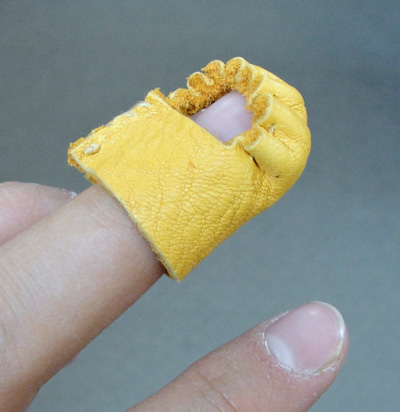
Bede, I admire your scientific spirit. Probably, the last photo is too large, make people to think that leather thumb glove is as big as a a sock?Bede wrote:Another question, are you writing about the width of your thumb or the length? It is starting to sound like a finger stall from your comment unless you have a very large thumb.
Furthermore, archaeologists just discovered one leather thumb glove in a grave.
BTW: Stephen, I still have a problem to upload the photo in the forum of "Archery literature". Do you think it is kind of bug of this BBS?
You do not have the required permissions to view the files attached to this post.
Last edited by serindia on Sat Jun 12, 2010 6:48 pm, edited 1 time in total.
-
serindia
- Posts: 46
- Joined: Fri May 19, 2006 12:27 am
- Location: Napoli
You are welcome. The director of Turfan Bureau of Cultural Heritage, Dr. LI Xiao and the researcher of Xinjiang Institute of Cultural Relics & Archaeology, Prof. L? Enguo are invited by DAINST. They will visit Eurasin Department of DAI in Berlin on Jun 14th. Generally, they will give some lectures in the DAI. If you are interested, please contact with the Deputy Director of Eurasian Department of DAI, Prof. M. Wagner. I think the event could be arranged by her.JJ wrote:Serindia, thank you very much for these pictures!
This leather protection is really cool. It is only a question of it?s dimension to determine if it was a finger tab or thumb protection. Can we get information on length/ width of this exceptional find?
As far as I know, old chinese thumb rings indicate that their thumbs were much smaller than ours are today. Of hundreds of old manchu design thumbrings I?ve had in my hands, maybe 2 or three fitted on my thumb, which is quite small.... That would be in favour of a thumb protection.
JJ
-
serindia
- Posts: 46
- Joined: Fri May 19, 2006 12:27 am
- Location: Napoli
-
Stephen Selby

- Posts: 1452
- Joined: Thu Mar 10, 2005 1:10 pm
- Location: Hong Kong
- Contact:
Maybe I'm a bit hazy about exactly where I handled the thumb-ring. It wasn't at the actual Yanghai site but at the store where the Yanghai excavation materials were being stored.
It's fine to label it as a 'thumb-ring', but it is not an archer's thumb-ring. It is constructed so as to stop it slipping up the thumb on applying downward pressure, like piercing thick hide with a needle; but it would be useless for shooting as it would come off the tip of the thumb on release. Even when I asked a lady colleague with small hands to put it on, she couldn't get it over her thumb to the first joint. Hence it's not an archer's thumb-ring. Given the strong economic interest of the inhabitants of the graves in leather-work, a thimble would be a more natural explanation.
I don't know if it was excavated with a male or a female corps. The females often had sewing equipment buried with them.
-
serindia
- Posts: 46
- Joined: Fri May 19, 2006 12:27 am
- Location: Napoli
Sir, you are reasonable! I suggest you to add the discussion in your presentation of NWU on Sep.Stephen Selby wrote:Maybe I'm a bit hazy about exactly where I handled the thumb-ring. It wasn't at the actual Yanghai site but at the store where the Yanghai excavation materials were being stored.
It's fine to label it as a 'thumb-ring', but it is not an archer's thumb-ring. It is constructed so as to stop it slipping up the thumb on applying downward pressure, like piercing thick hide with a needle; but it would be useless for shooting as it would come off the tip of the thumb on release. Even when I asked a lady colleague with small hands to put it on, she couldn't get it over her thumb to the first joint. Hence it's not an archer's thumb-ring. Given the strong economic interest of the inhabitants of the graves in leather-work, a thimble would be a more natural explanation.
I don't know if it was excavated with a male or a female corps. The females often had sewing equipment buried with them.
Futhermore, at Dongheigou Site, Barkol, Dr. MA Jian and our colleagues excavated many bone objects, which including the plate armour. Probably, you can help them to identify some archery wares. I heard that, they are kept in the store of Xi'an Section, Archaeology Institute of CASS.
-
jack farrell
- Posts: 1864
- Joined: Sun Mar 13, 2005 3:40 am
- Location: Texas
I can accept Stephen's reasoning on the bone thimble. Now here is my reservation about the thumb protector. This is a traditional Eskimo thimble from Alaska:
http://www.alaskafurexchange.com/images ... himble.jpg
http://www.alaskafurexchange.com/images ... himble.jpg
-
jack farrell
- Posts: 1864
- Joined: Sun Mar 13, 2005 3:40 am
- Location: Texas
There is an ivory thimble in the book THE ESKIMO ABOUT BERING STRAIGHT very similar to the bone thimble posted by Serindia. Notably the ivory thimble has a stirrup to fit back over the finger (Not thumb). The book is a reproduction of an old Bureau of Ethnography (former name of the Smithsonian) one. The item was collected in the late 1800s. p. 109.
-
Bede
- Posts: 2360
- Joined: Mon Mar 14, 2005 11:57 am
- Location: Sydney, Australia
When I saw the bronze ring in Korea in the Silk Road Museum, I immediately thought of the thimble too. I think Jack's comparisons are very apt. The Eskimos and the people of Pazyryk (who lived a Scythian lifestyle) both were very adept at sewing leather with extremely fine stitching. The number of stitches per centimetre is astonishing. Thousands of stitches could be used in even a simple garment. It would be surprising if they did not have effective thimbles.
Bede
-
jack farrell
- Posts: 1864
- Joined: Sun Mar 13, 2005 3:40 am
- Location: Texas
-
Stephen Selby
- Posts: 1452
- Joined: Thu Mar 10, 2005 1:10 pm
- Location: Hong Kong
- Contact:
-
Bede
- Posts: 2360
- Joined: Mon Mar 14, 2005 11:57 am
- Location: Sydney, Australia
Stephen,
I doubt if any one using any of the more powerful bows in Xinjiang used a pinch draw. Pinch draws are relatively rare except for children's bows and other moderately light bows. Large nocks are not necessarily an indication of a pinch draw.
I think the leather protector is functionally related to the leather finger stalls used but the Bhutanese. Such a device is probably not suited to a standard thumb draw. I would not rule it out, but there would have to be more evidence to narrow it down. It is perfectly reasonable that the object is a finger stall. Individual ones of the type the Bhutanese archers use would easily become separated and lost. Modern ones are connected to a wrist strap to prevent that problem.
The Bhutanese archers I met could make a set of finger stalls in minutes. These finger stalls were used to pull heavy bows in my presence though I don't think any were 100 pounds.
Bede
-
Adam Karpowicz
- Posts: 753
- Joined: Sun Mar 13, 2005 11:57 am
- Location: Canada
I think Stephen meant the nocks are too shallow to keep the arrow attached to the string during the thumbdraw.
It seems the arrows were used with the three-finger draw (or two-finger). In this case the shallow nocks will be useable, and the leather protector could then be one of the surviving finger stalls as Bede suggests.
Adam
It seems the arrows were used with the three-finger draw (or two-finger). In this case the shallow nocks will be useable, and the leather protector could then be one of the surviving finger stalls as Bede suggests.
Adam