
I hope I have finally determined the form of the bow of St.Mercurius, painted on frescoes in Lesnovo I inserted at the beginning of this topic. Since a similar bows appear on several frescoes , the bow of St Procopius from the same monastery served as a model for revival of the bow only partially visible..
It is a similar design, although bow of St. Mercurius has more reflexed limbs, which causes a greater distance between the string and grip. As in all Serbian frescoes where bows are visible as a whole, they have a strongly reflexed grip, I?ve determined stronger reflex at the handle and I think it could be the ultimate form.
On the bow of sv.Prokopije from Lesnovo, the shape of this bow was not difficult to determine. The distance between the string and the handle is smaller, but what they have in common is sloped nock at the ears where the string is attached.
My opinion is that these ones are two different bows of similar design. The bow of st.Mercurije possibly tends to early version of tatar bow type that later evolved into the Crimean Tartar bow with set back handle.
Length of unstrung bows could be 126 cm or a bit more.
In making replicas I'll take care of several things:
1. the bows do not have to be hornbows but even ?two wood? bows.
2. white color on the belly implies birch bark or other material used for decoration, such as silk.
Since the experiment with the horn could be quite expensive at first attempts I will work on ?two wood? bows with the same method as hornbows, using several layers of sinew.
After successful reconstruction of 3 bows could make sense I will work with horn and then many other bows that appear in the frescoes.
2 Serbian bows-''graphic'' reconstruction of bow shape by
-
Zoran Pavlovic

- Posts: 219
- Joined: Mon Mar 14, 2005 2:01 pm
- Location: Serbia
You do not have the required permissions to view the files attached to this post.
Last edited by Zoran Pavlovic on Mon Mar 21, 2011 7:02 pm, edited 2 times in total.
serbianbow
-
Bede

- Posts: 2360
- Joined: Mon Mar 14, 2005 11:57 am
- Location: Sydney, Australia
Has anyone studying Serbian bows noticed when depictions of archers first showed arrows with different coloured feathers? There have been some discussions about this in the context of French and English archery. Different coloured fletching implies that you look at the arrow when you nock it to see which way it attaches to the arrows. Some people assume that this is a sign of target equipment.
In a artwork this implication is not necessary. An artist will often choose the most attractive version of an object to illustrate. In the case of a saint, perhaps there is a subtext that the arrows will be always be as accurate as target arrows.
In a artwork this implication is not necessary. An artist will often choose the most attractive version of an object to illustrate. In the case of a saint, perhaps there is a subtext that the arrows will be always be as accurate as target arrows.
Bede
-
Zoran Pavlovic
- Posts: 219
- Joined: Mon Mar 14, 2005 2:01 pm
- Location: Serbia
Bede,
Different color of feathers appears at several frescoes.In this topic I just focused myself on bows but it is good chance to consider other facts. Knowing the fact that only war equipement is depicted, different color could imply cock feather so that archer could easy manage with arrow but I don't think it could be target arrow. Also, arrow is longer than average arrows (which appears at most of frescoes) in comparison to whole body of saint which could imply drawing till the ears or so.
Different color of feathers appears at several frescoes.In this topic I just focused myself on bows but it is good chance to consider other facts. Knowing the fact that only war equipement is depicted, different color could imply cock feather so that archer could easy manage with arrow but I don't think it could be target arrow. Also, arrow is longer than average arrows (which appears at most of frescoes) in comparison to whole body of saint which could imply drawing till the ears or so.
serbianbow
-
Bede
- Posts: 2360
- Joined: Mon Mar 14, 2005 11:57 am
- Location: Sydney, Australia
Zoran,
What I meant was that horse archers in particular and any archers who have to shoot quickly must train themselves not to look at the arrows when nocking. A different coloured cock feather would be wasted in this situation. However, in the deliberate process of target shooting, there would be time for more careful inspection of the equipment.
Regarding the painting, I am not suggesting the arrows are target arrows, but that the artist added details that might not have been in the original to make a better looking picture. Perhaps all arrows were made with separately coloured cock feathers, but military arrows are often mass produced and perhaps not as refined as target arrows.
Bede
-
jkekoni

- Posts: 332
- Joined: Mon Sep 03, 2007 6:14 am
- Location: Espoo,Finland
2. white color on the belly implies birch bark or other material used for decoration, such as silk.
... or white wood, such as mapple, birch or hazel. Or that the dark horn was not paineted since it would be hard to tell apart from dark backround and dark armour.
Or whitish horn or horn that the bleached to whitish. (Urea bleached hair, why not horn?)
... or white wood, such as mapple, birch or hazel. Or that the dark horn was not paineted since it would be hard to tell apart from dark backround and dark armour.
Or whitish horn or horn that the bleached to whitish. (Urea bleached hair, why not horn?)
-
Zoran Pavlovic
- Posts: 219
- Joined: Mon Mar 14, 2005 2:01 pm
- Location: Serbia
Bede,Bede wrote:Zoran,
What I meant was that horse archers in particular and any archers who have to shoot quickly must train themselves not to look at the arrows when nocking. A different coloured cock feather would be wasted in this situation. However, in the deliberate process of target shooting, there would be time for more careful inspection of the equipment.
Regarding the painting, I am not suggesting the arrows are target arrows, but that the artist added details that might not have been in the original to make a better looking picture. Perhaps all arrows were made with separately coloured cock feathers, but military arrows are often mass produced and perhaps not as refined as target arrows.
It happens to me to react hastily sometimes.It is difficult to me to understand professional phrases in english language suddenly.Yes, Why not target arrows as you suggested. Of course that archer needed to practice archery regularly and to shoot target, though surely not ''victorian targets'' but e.g. ''shooting the apple through the ring''. Sometimes i behave like that i discovered ''cock feather'' and archery

Best regards,
Last edited by Zoran Pavlovic on Sun Jun 06, 2010 3:03 pm, edited 1 time in total.
serbianbow
-
Zoran Pavlovic
- Posts: 219
- Joined: Mon Mar 14, 2005 2:01 pm
- Location: Serbia
Or why not ram's horn.jkekoni wrote:2. white color on the belly implies birch bark or other material used for decoration, such as silk.
... or white wood, such as mapple, birch or hazel. Or that the dark horn was not paineted since it would be hard to tell apart from dark backround and dark armour.
Or whitish horn or horn that the bleached to whitish. (Urea bleached hair, why not horn?)
Since buffalo is not domestic animal in Balkan peninsula it was easier to obtain long sheep horn from autochtonous sheeps of Balkan called ''pramenka'' (in Serbia and Montenegro svrlji?ka, pirotska, karakačanska-old long horn breed from Greece present even in Serbia and Bulgaria,very rare today, sjenička, or lička, dalmatinska,istarska in Croatia). There was semi-dependent shepperd population called ??vlachs?? in medieval Serbia whom Codex of emperor Dushan explicitly mentioned under category called ??Sebri??.
Wow, seems it will be very hard work
 love it.
Thank you jkekoni, thank you Bede.
Regards,
serbianbow
-
MupKo
- Posts: 59
- Joined: Sun Mar 30, 2008 10:46 pm
- Location: Novi Sad, Serbia
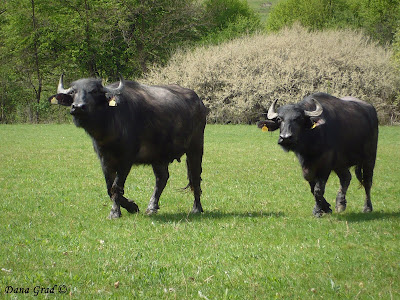
Hi! There were water buffalos (Биво) in Serbia, Balkan, and rest od South Eastern Europe (even Italy). They were introduced as early as VI century with Avar invasion. (Buffon, Oeuvres comletes, vol 4. Paris, 1938)
In Serbia water buffalos were bred since 1200. (at least) Dechani Monastery had water buffalo breeders (Биволари). (Ulmanski, Bivo, Narodna enciklopedija Srpsko-hrvatsko-slovenacka, I knjiga, Zagreb, 1926)
In Serbia water buffalos were bred since 1200. (at least) Dechani Monastery had water buffalo breeders (Биволари). (Ulmanski, Bivo, Narodna enciklopedija Srpsko-hrvatsko-slovenacka, I knjiga, Zagreb, 1926)
-
Bede
- Posts: 2360
- Joined: Mon Mar 14, 2005 11:57 am
- Location: Sydney, Australia
That is very interesting. I knew about the buffalo in southern Italy, but the early introduction into the Balkans is interesting. I doubt the Avar connection though. They were nomads and had no use for water buffalo though they probably used their cattle to pull their carts like modern Mongols. The steppe is not a good habitat for water buffalo.
Did they make a cheese like mozzarella in the Balkans with buffalo milk?
In English, there is confusion in common speech between oxen (any castrated male cattle used for hauling), steers (castrated male cattle used for food) and the general term cattle referring to all bovines including water buffalo. Another term for oxen is bullocks which has a similar derivation and is strongly associated with haulage.
Does the Serbian word, Биво, have a similar derivation to the English, beef?
Bede
-
ginni

- Posts: 250
- Joined: Fri Jan 12, 2007 7:09 pm
- Location: romania
- Contact:
-
redhawk
- Posts: 618
- Joined: Sun Mar 20, 2005 9:45 pm
- Location: GERMANY,Schopfheim
- Contact:
Ginni, you?ve to look for the younger cattle.
The buffalos in Italy are breeded for the real mozzarella, the breeders are obligated by law to care for a watering hole.
Of much more interest is the Podolica- cattle in the very south of Italy, who is directly descended from Anatolia.
The horns of Podolica- cattle are looking like a perfect bow.
Michael
-
MupKo
- Posts: 59
- Joined: Sun Mar 30, 2008 10:46 pm
- Location: Novi Sad, Serbia
We have less terms in Serbian.
Cattle=goveda
Bull=bik
Castrated male=vo
Water buffalo=bivo
In old serbian it was bivol, so Ginni, we share term. L was lost in singular, but preserved in plural-bivoli, and term for female-bivolica.
WB were mainly used as draft animals in Serbia. Two wb do the same work as 3 oxes. They are faster than oxes, and slower than horses, ideal for many jobs. In 1997 there was around 16000 wb in Serbia, but today their number is much much less, and they are protected as genetic resource.
WB skin was very appreciated. And horn? Don't know. Young wb from Serbia, 18-20 months old, with 290kg body weight had 1,4kg horns (0,7kg each). (Ognjanovic, 1974) Full grown male have 500-700kg. 97% of wb population is in Asia, so best horns are surely there.
You do not have the required permissions to view the files attached to this post.
-
MupKo
- Posts: 59
- Joined: Sun Mar 30, 2008 10:46 pm
- Location: Novi Sad, Serbia
-
MupKo
- Posts: 59
- Joined: Sun Mar 30, 2008 10:46 pm
- Location: Novi Sad, Serbia