
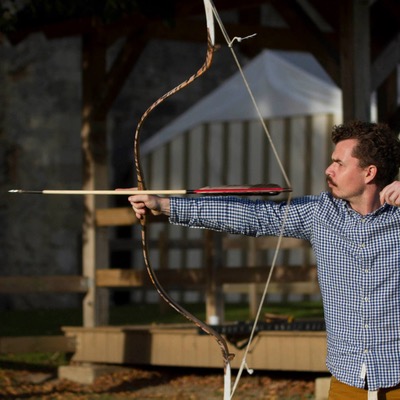
string placement on cylindrical ring

This is where we discuss techniques used in Asian archery.
User avatar
Peter Dekker
Site Admin
Posts: 171
Joined: Sun Oct 01, 2006 11:21 pm
Location: the Netherlands
Contact:

Post by Peter Dekker » Mon Jun 20, 2011 9:19 pm

Bede wrote:I have a ring with a silver lining inscribed with the owner's name. that is the only tipe of lining I have seen in rings from the Qing Dynasty, but that doesn't mean there weren't other methods used.
Same here, I've also seen some jade rings with silver lining. It's great to have something with a name on it. Is the name in Chinese or Manchu? It goes without saying that I'd love to see pics. :)

Bede wrote:In the Tibetan region, is is possible that the ring using technique was different from the Manchu military method.
I agree. There is that picture from the Bundesarchiv where a Tibetan archer uses a similar ring but with a different technique:
Image
Bede wrote:I have found out something interesting recently. It is winter in Australia and in the colder temperature, the old jade ring I practice with has become more comfortable and I no longer get the red mark below the thumb nail. Obviously in the cold the ring is looser since my thumb is smaller, but I think it might be less blood flow in the surface skin that prevents the red mark.
Now that is interesting, considering the cold temperatures up in Manchuria in winters. They also usually attacked in winter, as it was easier to move over frozen water and many layers of protective clothing wouldn't be as warm as they would be in summer.

Jack:
You might be right. I thought it was bone because of all the holes where the blood vessels used to be, but I understand some parts of deer antler also have this. Is there any definite way to find out whether it's antler or bone, perhaps under magnification?

-Peter

jack farrell
Posts: 1864
Joined: Sun Mar 13, 2005 3:40 am
Location: Texas

Post by jack farrell » Tue Jun 21, 2011 1:07 am

Peter; I think we had this discussion about a year ago here. Didn't JJ post a pic?

Too bad you are not here. Chinese deer (elk?) are kept on game farms here and the antlers are available. The base is very thick and could make such a ring. Whole antlers have minimal restrictions and crafts pass unrestricted. Not my business though.
User avatar
Peter Dekker
Site Admin
Posts: 171
Joined: Sun Oct 01, 2006 11:21 pm
Location: the Netherlands
Contact:

Post by Peter Dekker » Tue Jun 21, 2011 4:52 pm

Hi!

I remember a discussion about the material of my whistler a while back, but there was no info posted on how to distinguish antler from bone. I'm going to have to make some close-up shots for you guys.

-Peter
User avatar
Justin Ma
Posts: 309
Joined: Fri Feb 05, 2010 6:00 am
Location: Bay Area, California, USA
Contact:

Post by Justin Ma » Tue Jun 21, 2011 5:27 pm

Peter, can you say what the angle of the slope is on the convex/base edge of the ring (as well as for the concave edge)? You can express as the length of the sides of a right triangle, where the sloping edge is the hypotenuse.

Also, does it matter how tall the ring is?
jack farrell
Posts: 1864
Joined: Sun Mar 13, 2005 3:40 am
Location: Texas

Post by jack farrell » Wed Jun 22, 2011 2:30 am

Peter; Glad you brought up your whistler. Are you now convinced that the material is wood after seeing a broken identical item in the Ashmolean?

I was surprised.
User avatar
Bede
Posts: 2360
Joined: Mon Mar 14, 2005 11:57 am
Location: Sydney, Australia

Post by Bede » Wed Jun 22, 2011 7:02 am

Telling bone from antler.
Both bow and antler have a spongy core. However, the way that they are laid down is different. Antler is built up by a layer of tissue called velvet. All the blood vessels are in the velvet. Once the velvet is shed, the antler is effectively a dead projection of the skull. However, bow is alive and has communication between its interior and the rest of the body. There are microscopic blood vessels running through the bone.

Inscription on the Ring
It is Chinese characters and very hard to see. I will try to photograph it with my USB microscope, but I do not hold out much hope of a clear picture.
Bede
User avatar
Justin Ma
Posts: 309
Joined: Fri Feb 05, 2010 6:00 am
Location: Bay Area, California, USA
Contact:

Post by Justin Ma » Wed Jun 22, 2011 1:39 pm

Justin Ma wrote:Peter, can you say what the angle of the slope is on the convex/base edge of the ring (as well as for the concave edge)? You can express as the length of the sides of a right triangle, where the sloping edge is the hypotenuse.
Nevermind. I was looking at the schematic again, which seems to suggest a 45-degree angle for the slopes, although the base edge slope should be more curved.
User avatar
Bede
Posts: 2360
Joined: Mon Mar 14, 2005 11:57 am
Location: Sydney, Australia

Post by Bede » Sat Jun 25, 2011 3:09 am

Justin,
The slope is not critical. I have been checking the rings I use and some have almost flat bases and others where the angle is less than 40 degrees, possibly only 30. The other end is equally variable. Sometimes it is closer to a radiused finish rather than an angle. The major consideration is not to have sharp edges.

At full draw, the axis of the ring is parallel with the arrow so what you need is a shape that doesn't damage the string at that position.
Bede
User avatar
Peter Dekker
Site Admin
Posts: 171
Joined: Sun Oct 01, 2006 11:21 pm
Location: the Netherlands
Contact:

Post by Peter Dekker » Wed Jun 29, 2011 11:05 pm

jack farrell wrote:Peter; Glad you brought up your whistler. Are you now convinced that the material is wood after seeing a broken identical item in the Ashmolean?

I was surprised.
My whistle is some kind of very dense bone, the vessels clearly show up under magnification. We may never find out what kind of bone though. :)

I did see a broken whistle, it was in the reserve collection of the Royal Armories in Leeds. It was of a slightly different type, used for a horseback target archery game. That whistle was made of burl wood combined with horn. The regulations for this whistle mention yangjiao, which can be goat or ramshorn. Its identical counterpart, which is not broken, is on display in the same museum.

Thanks Bede fot the explanation telling antler from bone. I think the ring is bone then. It has vessels, small and larger, throughout.

-Peter
Post Reply