
This is exactly how I would made my bow.If I was building this bow I would construct it in the manner of a Korean bow; two limbs in one piece bent in the middle with a strong riser glued on, V-spliced on ears which were pre bent, maybe an extra piece to fill in the tall end nock piece
Rough plan for splicing the ears in Serbian bows
-
ginni

- Posts: 250
- Joined: Fri Jan 12, 2007 7:09 pm
- Location: romania
- Contact:
-
Zoran Pavlovic

- Posts: 219
- Joined: Mon Mar 14, 2005 2:01 pm
- Location: Serbia
Jack,
Your suggestion looks very logical. Bencsik Peter from Botonbow is best exemple and construction that he explained is great proof about making stronger bend.Also, this construction allows tapering along the line of V splice till the tips which can approve why Serbian bows have more tapered limbs (maybe V splice is deeper).This construction also allows lack the long ridge as it is not case in later Ottoman bow improvment.
I agree with you about preshaping the limbs with riser glued onto the core,this is my idea from the beginning.Uli already approved it though it couldn't be possible with thickness over 1cm (if i am right, Uli pls correct me if i am wrong:),do mean Korean manner of preshaped limbs since they use bamboo unlike area where bows i need to reconstruct allow only maple,ash, mulberry etc. as a core.
*When i replicated to Kalojan about Ottoman influences i didn't mean construction of the bow but design at the first place, maybe i understood him wrong.
Though, composite bows of short form appear on several Byzantine engravings from 10th century(e.g.St.Demetrios), short form, short ears same as in Serbian bows. So, this sort of construction shouldn't be only invention in Ottoman empire, and design shouldn't be of Kipchac/Tatar influence despite quivers as typical nomadic armament and fashion.
Anyway, thank you very much, you enlightened my thoughts;-)...guess is more than educated. So, i will try several options.
#Ginni, i would be glad to see some of your Romanian bows reconstructions.
Best regards,
Zoran
serbianbow
-
ginni
- Posts: 250
- Joined: Fri Jan 12, 2007 7:09 pm
- Location: romania
- Contact:
 )
-
Kalojan
- Posts: 17
- Joined: Wed Oct 05, 2011 8:26 am
- Location: Austria
Not so true. early byzantine Art was still influenced by the Roman Art, and bows allways looked like Scythian Bows. I don't even see ears on the Bow of for example St. Demetrios, it looks much to scythian to me...Zoran Pavlovic wrote:Though, composite bows of short form appear on several Byzantine engravings from 10th century(e.g.St.Demetrios), short form, short ears same as in Serbian bows.
-
Zoran Pavlovic
- Posts: 219
- Joined: Mon Mar 14, 2005 2:01 pm
- Location: Serbia
Kalojan wrote:
Not so true. early byzantine Art was still influenced by the Roman Art, and bows allways looked like Scythian Bows. I don't even see ears on the Bow of for example St. Demetrios, it looks much to scythian to me...
Kalojan,I tnink it is clear here.Byzantine Icon of St.Demetrios, 10th century.There's no any doubt is this scythian type that appears in Greek,Etruscan or Scythian art or type we discuss here.
Поздрав,
You do not have the required permissions to view the files attached to this post.
Last edited by Zoran Pavlovic on Tue Nov 15, 2011 12:40 pm, edited 1 time in total.
serbianbow
-
JJ

- Posts: 317
- Joined: Mon Dec 08, 2008 9:38 am
- Location: Germany
Zoran,
I think these bows are very typical examples of a type very common in wide parts of Eurasia before and around the time of the mongol invasions.
Some time ago there was a discussion here on Atarn on these "Crab-leg-bows". There are examples of depictions in art from China, Byzance and even early medieval Spain. They belong to the non-contact siyah type group with bone stiffeners (Hunnic type bows).
They have not much in common with Scythian bows...
JJ
-
Zoran Pavlovic
- Posts: 219
- Joined: Mon Mar 14, 2005 2:01 pm
- Location: Serbia
-
Kalojan
- Posts: 17
- Joined: Wed Oct 05, 2011 8:26 am
- Location: Austria
Crab Bow? For sure not! Where do you see on this depictions any siyas? Crab-Leg-Bows had Siyas, which were quite long.
This bow hasn't any siyas! It is a typical kind of bow depicted in traditional art of early byzantine era, which is still under strong ancient roman influence. The Kind of showing more of the "real life" came later, in the Second Half of the 13th Century (great example is there the Church of Boyana in Sofia).
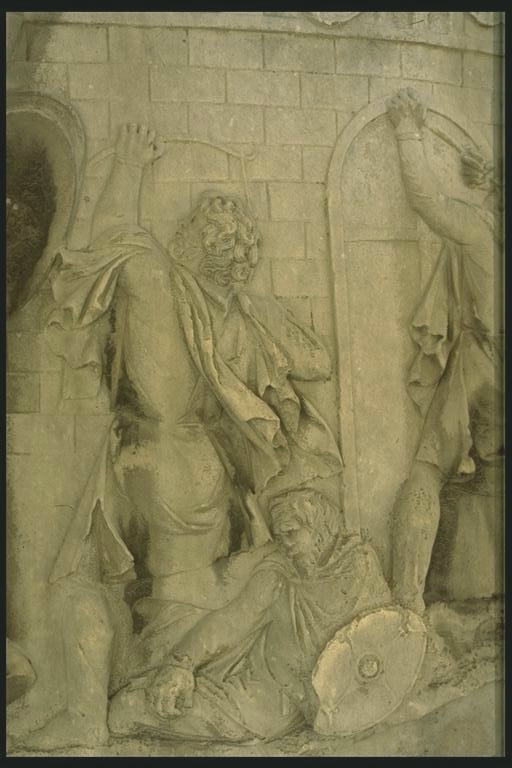
Not so much difference there, isn't it?
In the 10th Century btw. was the Byzantine Empire in Contact with the Magyars, so it seems normal to me that they copied the Magyar Bows, like they copied before the Avar Bows (there are some findings of Sivas of such bows on ex-byzantine Territory).
This bow hasn't any siyas! It is a typical kind of bow depicted in traditional art of early byzantine era, which is still under strong ancient roman influence. The Kind of showing more of the "real life" came later, in the Second Half of the 13th Century (great example is there the Church of Boyana in Sofia).
Not so much difference there, isn't it?
In the 10th Century btw. was the Byzantine Empire in Contact with the Magyars, so it seems normal to me that they copied the Magyar Bows, like they copied before the Avar Bows (there are some findings of Sivas of such bows on ex-byzantine Territory).
You do not have the required permissions to view the files attached to this post.