-
Board index
-
- It is currently Sat Oct 24, 2026 11:12 am
- All times are UTC
This is where we discuss the bows, arrows, quivers and other hardware used in Asian archery.
-
JJ
- Posts: 317
- Joined: Mon Dec 08, 2008 9:38 am
- Location: Germany
Post
by JJ » Thu Jan 26, 2012 2:51 pm
-
scemdonmez
- Posts: 224
- Joined: Fri Dec 16, 2005 8:58 pm
- Location: izmir/TURKEY
Post
by scemdonmez » Thu Jan 26, 2012 6:06 pm
Great pics, thanks.
Cem
-
Justin Ma
- Posts: 309
- Joined: Fri Feb 05, 2010 6:00 am
- Location: Bay Area, California, USA
-
Contact:
Post
by Justin Ma » Thu Jan 26, 2012 7:27 pm
Haha, I can't get enough of this bow. Would love to see how it would look when it's strung. (My insistent guess is that this is very similar to the Chinese/Ming Kaiyuan bow because of its long kasan and short working limbs.)
-
jack farrell
- Posts: 1864
- Joined: Sun Mar 13, 2005 3:40 am
- Location: Texas
Post
by jack farrell » Thu Jan 26, 2012 9:11 pm
I would love good pics of the siyahs from the back side. The shape and placement of the ridge will speak much to its place on the bow making chronology.
The string has so many strands that silk or fiber soaked in a hardener might be a possibility. Sinew would be so edible to critters.
-
JJ
- Posts: 317
- Joined: Mon Dec 08, 2008 9:38 am
- Location: Germany
Post
by JJ » Fri Jan 27, 2012 8:57 am

Jack, here?s the front of the upper siyah. because of backlight it is not of very good quality, but one can clearly see a flat back ridge
...and even the outlines of the V-splice

The string to me looked like sinew fibers, but in the catalogue text it is stated that it would be silk. However, in the appendix with material analyses no analyse is given for the string. The fibers are quite coarse, is this possible with silk?
JJ
-
jack farrell
- Posts: 1864
- Joined: Sun Mar 13, 2005 3:40 am
- Location: Texas
Post
by jack farrell » Fri Jan 27, 2012 2:16 pm
Jurgen; Really these are very good pics and precious material.
I would describe the siyah above the bend as sub triangular. There indeed is a flat ridge. I do not see the V splice, only a stain from glue or saliva from the sinew of the back having being eaten off.
I look at the lower string knot where it was cut off facing us. The fluffed up end makes a kind of tassel. There appears to be twice as many fibers as I see in my sinew strings.
These posts I made on the three bows are merely observations as I have not seen the bows in person.
-
JJ
- Posts: 317
- Joined: Mon Dec 08, 2008 9:38 am
- Location: Germany
Post
by JJ » Fri Jan 27, 2012 2:36 pm
Jack, there?s even a slot at the end of the splice just like in Korean Gakgungs....
Try to post a detailled view of it.
JJ
-
JJ
- Posts: 317
- Joined: Mon Dec 08, 2008 9:38 am
- Location: Germany
Post
by JJ » Fri Jan 27, 2012 2:41 pm

I think there?s no doubt about the splice....
JJ
-
JJ
- Posts: 317
- Joined: Mon Dec 08, 2008 9:38 am
- Location: Germany
Post
by JJ » Fri Jan 27, 2012 2:47 pm
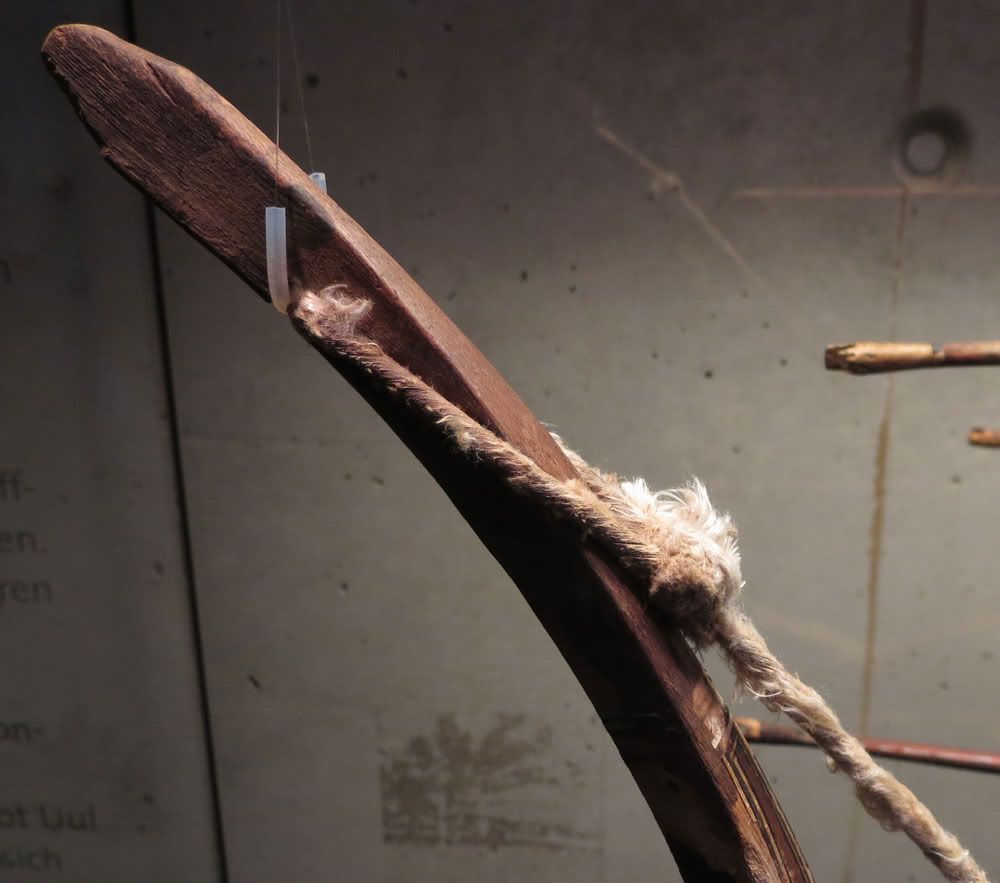
Checked the upper string loop photo and I think you are right, Jack. The fibers look too soft to be sinew;-)
-
jack farrell
- Posts: 1864
- Joined: Sun Mar 13, 2005 3:40 am
- Location: Texas
Post
by jack farrell » Fri Jan 27, 2012 7:21 pm
Jurgen; I see what may be a saw cut and some other suggestions of a V splice but I am not sure about this. The cut seems a little too high up to allow a sufficient splice, which should be prominent in your photo. Nevertheless, this bow is in the correct period for a V splice. It also shares the triangular tips with the Ss bow (without the horn inserts) and Rashid ed din illustrations, but it is more developed and belongs to a different "school" of bowmaking. Now they import silk in a raw form from China to Mongolia.
Just where is the stepped pattern from the illustration? above the grip?
Can anyone describe the string knot shown intact on the lower loop?
-
Adam Karpowicz
- Posts: 753
- Joined: Sun Mar 13, 2005 11:57 am
- Location: Canada
Post
by Adam Karpowicz » Sat Jan 28, 2012 8:20 pm
Great pictures! Would you say the width of limbs at mid point of the bending part is 6-7cm? And the thickness about 1.5cm? Less than that?
It could be a V-splice for the siyahs. How about the grip joinery in these bows? was it a vertical scarf?
Adam
-
JJ
- Posts: 317
- Joined: Mon Dec 08, 2008 9:38 am
- Location: Germany
Post
by JJ » Sun Jan 29, 2012 12:10 am
Jack, I see the splice quite clearly in the picture above. There is a dark triangle directly at the cut, which can?t be by accident.
Adam, the bow is not that wide, perhaps about 5 cm, and under 2 cm thick, I would say.
JJ
-
Adam Karpowicz
- Posts: 753
- Joined: Sun Mar 13, 2005 11:57 am
- Location: Canada
Post
by Adam Karpowicz » Tue Jan 31, 2012 1:58 pm
I made a calculation (the formula is in my book) to assess the draw weight of this bow, by comparing it to a bow I made of somewhat similar shape. Assuming this bow is 140cm long ntn, 5cm wide x 1.5cm thick, it would be 100lb @ 28in or a little over that. If 1.8cm thick, then the weight would go up to about 150lb. 1.5cm is more probable for a bare bow with no cover.
Adam
-
JJ
- Posts: 317
- Joined: Mon Dec 08, 2008 9:38 am
- Location: Germany
Post
by JJ » Tue Jan 31, 2012 2:50 pm
I think that the limb thickness is around 1,5 cm . Perhaps even less without the birch bark...
Any photo of the bow of similar shape
?
JJ
-
Patrick Menzies
- Posts: 122
- Joined: Sun May 08, 2005 12:39 am
- Location: Ontario
Post
by Patrick Menzies » Tue Jan 31, 2012 3:44 pm
Nothing about any of these bows suggest such a high draw weight. The unreinforced tips in particular.
Last edited by
Patrick Menzies on Wed Feb 01, 2012 2:46 am, edited 1 time in total.