Qabaq game

This is where we discuss Asian horseback archery.
Post Reply
User avatar
Steppenreiter
Posts: 8
Joined: Fri Dec 09, 2005 9:03 am
Location: Germany, Black Forest
Contact:

Qabaq game

Post by Steppenreiter » Fri Dec 09, 2005 7:26 pm

Hello to everybody,

Redhawk invited me to join your group. (Hello Stephen long time no see! Unfortunately you're thumb ring broke a few weeks ago you gave me in Leeds)
I'm horseback archerer since 9 years which I learnt from Kassai. Two years ago I left his group and am looking now for new challenges.

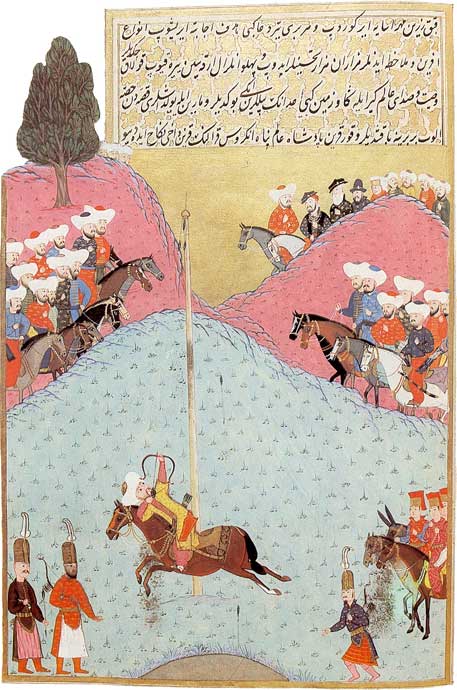
Next year during our yearly Steppereiter (horseback archery) Festival I want to show the Qabaq game which has turquish origin. While galopping under a pole they where shooting on a small target over their heads.

Has anybody of you an idea how long was the pole?, how small the target, what where the rules of this game. I read some ancient mamluck sources mentionned by Ayalon concenrning the game but I couldn't find any details.
Image

Thanks for your help

Steppenreiter
A day without improvement wasn't a good day
Andrew van Ross
Posts: 9
Joined: Sat Aug 13, 2005 12:18 pm
Location: germany

Post by Andrew van Ross » Fri Dec 09, 2005 10:45 pm

Without having anything to add to the topic:

Welcome to the board. A pleasure to have you around.

Andrew
User avatar
Stephen Selby
Posts: 1452
Joined: Thu Mar 10, 2005 1:10 pm
Location: Hong Kong
Contact:

Post by Stephen Selby » Sat Dec 10, 2005 2:21 am

Nice to see you here. I remember your display at Leeds Castle.

As to Qabaq: here are some photos of Mughal illustrations from an archery manual. These were donated to ATARN as part of the papers of the late Prof. Derek Latham.

You can find some details of Qabaq in Derek Latham's article: "Notes on Malmuk Horse Archers', Bulletin of the School of Oriental and African Studies, Vol. XXXII, part 2, 1969. He refers also to Prof. David Ayalon, "Notes on the furusiyya exercises and games in the Malmuk Sultanate." Studies in Islamic History and Civilization (Scripta Hieroslymitana, IX), Jerusalem, 1961, 31-62.

From Prof. Latham's paper:

In one account, a gilded cage with a dove in it was placed at the top of a mast, and archers had to shoot in such a way as to free the dove from the cage. They won honour and the cage as a prize.

Most sources define the Qabaq as a wooden hoop on top of a pole through which archers had to shoot. It could also be a gourd (from which the name 'qabaq originates), a cup, or the head of a rebel.

The paper does not contain any dimensions. In one account, the pole is said to be the mast of a ship.

According to the rules, the archer was not allowed to shoot until he had galloped past the pole. He had to shoot over the quarters.
You do not have the required permissions to view the files attached to this post.
User avatar
Steppenreiter
Posts: 8
Joined: Fri Dec 09, 2005 9:03 am
Location: Germany, Black Forest
Contact:

Post by Steppenreiter » Sat Dec 10, 2005 7:16 pm

Yes Stephen,

The mentionned article from Ayalon I've already read. Your pictures proved to me the fact that they where originnally enclosing doves in the qabaq. Must have been a nice view when it had been released while hitting the target. But no way for practicing today, animal laws and the pigeon as bird of peace in Germany - It would be sacrileg to shoot at!

Even though I'm sure nobody of us would be able to release them...

On the osmanic picture the target looks like a ring. We do have here in Germany May Trees, which are erected to welcome spring. They are about 15m high, which is an incredible height for a target. Do you think the pole were that high?
A day without improvement wasn't a good day
istanbuli
Posts: 17
Joined: Sun Sep 25, 2005 9:17 pm
Location: istanbul
Contact:

kabak game

Post by istanbuli » Sun Dec 11, 2005 2:05 am

dear all
when I saw the painting I noticed the Turkish text on it and decided to translate for the people who might be interested in.With a bit missing it goes as down here:


"When the golden courgette/pumpkin was shot (?) and every one of them (?) reaching to the target of divine acceptance like the arrow of prayer all the witnesses saying congratulations of every kind and the contestants adding thousands of thousands other compliments touched the back of their hands to the ground and pulled their ears right afterwards (as a talismanic, folkloric, protective gesture against an evil eye when a beauty or a success is seen) .Also amongst all their cheerful shouting that would cover the world they bent the backs of the enemy as big and powerful as the ?ox of earth? into two pieces.(the ox here is the one that once was believed to be holding the earth on between its two horns - in an Indian legend I guess ) Marian (?) and his fellows extracting their lesson from what had happened looked at each other and being rather frightened started murmuring: ?So may The Sultan, The Shelter for the people of earth, marry the daughter of the King of Magyar ???

I hope you have enjoyed. 8)
User avatar
Stephen Selby
Posts: 1452
Joined: Thu Mar 10, 2005 1:10 pm
Location: Hong Kong
Contact:

Post by Stephen Selby » Mon Dec 12, 2005 12:59 am

Thank you very much for this clear translation. I should like to reproduce the photograph and your translation in the 'picture archive' section of ATARN, so that it can be kept more permanently and be found more easily.

Do you agree?
User avatar
Bede
Posts: 2360
Joined: Mon Mar 14, 2005 11:57 am
Location: Sydney, Australia

Post by Bede » Mon Dec 12, 2005 12:49 pm

Thankyou Istanbuli for the translation. I thought that the target was a golden ball rather than a ring. The ring target was the birjas which was also used by lancers. Most paintings show the arrows sticking into the round top of the pole, indicating that it was a ball (replacing the qabaq or gourd).

Sir John Chardin describes qabaq shooting in Isfahan in the 17th century. There were several different types of target, including goblets of gold coins, the head of an enemy, and birds in cages that sprung open when the cage was hit from below. Usually the winner got the target as a prize if it was valuable. I am sure most practice was done with real gourds and pumpkins.

The game was played in modern times in the Caucasus and further east and the rules have been recorded. There are probably people alive who shot at this target.

I have the rules in a Soviet era book somewhere. I will see if I can find it. They specified the length of the course, the height of the pole and the number of arrows allowed to each competitor. I think some poles were about 25 feet high. It is described in some detail in Saracen Archery and seems to have been popular all over the East.

In Arab Archery, the author describes a safer practice setup where you have two poles and a rope between the tops with the qabaq suspended in between them. That way you could ride between the two without the danger of coming so close to a pole that your horse collided with it. Apparently this was the main type of accident.
Bede
istanbuli
Posts: 17
Joined: Sun Sep 25, 2005 9:17 pm
Location: istanbul
Contact:

Post by istanbuli » Mon Dec 12, 2005 6:02 pm

Dear Mr. Selby,
Thank you very much for your concern about keeping the painting in Atarn's Picture Gallery with the translation attached to it. So I revised it to be even more useful for the visitors and the members. Please feel free to use it as you wish.

And Mr. Bede, thank you too for the other valuable information.

efdaluddin

?When the golden courgette / pumpkin was hit by any of the arrows, like the arrow of a prayer reaching to the target of divine acceptance, all the witnesses said congratulations of every kind, and added thousands of thousands other compliments, and the contestants touched the backs of their hands to the ground and pulled their ears right afterwards (as a talismanic, folkloric, protective gesture against an evil eye when a beauty or a success is achieved). Amongst all their cheerful shouting that would cover the whole world, they bent the backs of the enemy as big and powerful as the ?ox of earth? into two pieces.(the ox here is the one that once was believed to be holding the earth on between its two horns - in an Indian legend I guess ) Thus, Marian (?) and his fellows, extracting their lesson from what had happened, looked at each other and -being rather frightened- started murmuring: ?So may The Sultan, The Shelter for the people of earth marry the daughter of the King of Magyar ???
Murat ?zveri
Posts: 90
Joined: Wed Mar 30, 2005 9:19 pm
Location: Istanbul,Turkey
Contact:

Post by Murat ?zveri » Tue Dec 13, 2005 11:28 am

Hi everybody,

Thanks for the perfect translation Istanbuli. By the way, Istanbuli (Efdaluddin) is one of the most important traditional caligraphers of our generation. Another traditional art that fortunately survived until today.

I recently received a private message from Steppenreiter about kabak shooting and will release the infomation about the length of the parcour which I'm sure was mentioned in Yucel's book. As long as I can remember the height of the target was not given clearly. I'll try to find out how it was described.

The target is of a size of a pumpkin. In Maemluk scripts it was mentioned that pigeons were shot, but in Ottoman time, 15th to 17th centuries in which kabak shooting had its highest popularity, cups made of cupper or gold had been shot. These cups has usually been the award to the competitor who won the game.

M.
User avatar
Steppenreiter
Posts: 8
Joined: Fri Dec 09, 2005 9:03 am
Location: Germany, Black Forest
Contact:

Post by Steppenreiter » Tue Dec 13, 2005 11:51 am

What a helpful group you are - thanks to everybody - I'm really amazed...

According my understanding as a reenactment person I may only tell you my observations when trying the game. I know always hitting to the side on a 10m distant target with a diameter of 30cm no matter how speedy the horse. To shoot upwards is incredibly much more difficult, especially when shooting backward up. Especially for this position you need a saddle with no or a very small pomel opposite to the one's being in use by all the ancient turkish people. I think Ayalon mentioned in his scripts such a kind of saddle.

Also it doesn't make sense to me to use arrows with point but to exercise the qabaq game with blunts. For safety reason according to my understanding it makes sense when shooting with fluflu fletches. But I'm really eager to learn from you how the old ones were playing the game.
A day without improvement wasn't a good day
User avatar
Bede
Posts: 2360
Joined: Mon Mar 14, 2005 11:57 am
Location: Sydney, Australia

Post by Bede » Tue Dec 13, 2005 1:15 pm

I have to agree with you about practising with blunts. This is much safer.

I have reread Taybugha in Saracen Archery and there is detailed information on shooting at the gourd target. He says to stand slightly in the stirrups and lean forward onto the saddle bow so the pommel is near the navel. High pommels were normal and I found they were an advantage. Modern Afghan saddles are good examples of the style and buz kashi riders throw themselves around on them in an manner that is quite frightening.

Ayalon mentioned a saddle with a flat cantle which Amir Badr ed-Din al Baysari used so he could lay flat on his horse's back and shoot upwards at the target. Another target mentioned was an apple! I agree that shooting at a qabaq is much more difficult than shooting horizontally. This probably why it was popular.

Most of the descriptions of practising for qabaq shooting sound more difficult than the process itself.

Murat, it is good to hear that calligraphy is still being done by experts.
Bede
sbartels
Posts: 33
Joined: Tue Apr 05, 2005 7:49 pm
Location: Europe

Qabaq practice

Post by sbartels » Tue Dec 13, 2005 6:07 pm

Hi Steppenreiter,
a few suggestions for your performance:

Height of the mast:
The paintings suggest a height of 8 to 10 meters, which would correspond with the height of the mast on a large dhow or shebeqe. The masts are rather short compared to western ships, it is the yard arms of the triangular lateen sails that reach up high and give these ships their graceful appearance.

Material
Blunts and six-fold high helical fletching should do the trick, I agree.

Target
My idea would be to take a pot (cooking-pot or something like that) with a lid on it (paint it golden to make it look less mundane...). Put a gas-filled balloon it it, put the lid on and pull it up the mast. Hitting the underside of the lid could (if you`re lucky) dislodge the lid and the balloon (perhaps with a silk ribbon/streamer attached) would rise into the air and fly away. Should be quite a sight...
User avatar
Stephen Selby
Posts: 1452
Joined: Thu Mar 10, 2005 1:10 pm
Location: Hong Kong
Contact:

Post by Stephen Selby » Wed Dec 14, 2005 1:39 am

My suggestion is to hang a bell up there and shoot blunts at it. There would be little room for argument over whether the target had been hit or not.
User avatar
Bede
Posts: 2360
Joined: Mon Mar 14, 2005 11:57 am
Location: Sydney, Australia

Post by Bede » Wed Dec 14, 2005 4:39 am

I would be a bit worried about being hit by the falling lid in one of the suggestions. The heavily fletched blunts sound good though.

At least one Persian painting I have seen shows a rope attached to the pole. The painting is not an engineering diagram however and it is hard to tell whether it was used to erect the pole or haul the ball to the top.

Popinjay targets usually were hoisted to the top of the pole by ropes and this would seem to be easier than pulling the pole down everytime you want to replace the target.

Using blunts, you need a target that moves or makes a noise when hit. The paintings show the target pierced so, in the old days, it was different.
Bede
istanbuli
Posts: 17
Joined: Sun Sep 25, 2005 9:17 pm
Location: istanbul
Contact:

Post by istanbuli » Wed Dec 14, 2005 5:53 pm

In Topkapi palace I remember seeing some bells having been pierced through by the arrows. Now they must still be in display there. But I do not know whether they were part of that Kabak game or not...
Post Reply