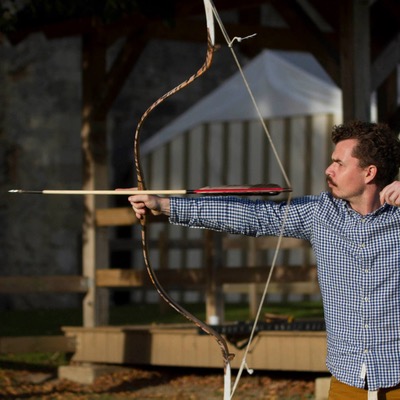
Orda Khan wrote:Agreed. I've argued many of these points on numerous occasions.That an arrow fails to penetrate in modern tests proves nothing as far as I'm concerned, not every soldier could afford good armour, let alone a full set of the latest, most well made.
One also frequently finds in texts that they shot the largest target on the battlefield first. Chinese poet Dufu: "Before you shoot the rider, shoot the horse." In the battle of Liegnitz the Mongols also supposedly weakened the knights and their horses with arrows before the heavy cavalry came in.
It is already pointed out that by far not all warriors would have the latest and best armor, but even fewer would be equipped with full horse armor. And if they were, their horses would tire out much sooner than that of the light cavalry. All trade-offs. And when their horses weakened, and their response time was affected, heavy cavalry could come in with armor piercing spears. I've got an 18th cent. armor piercing "
mao" spear from China, I don't think there are many armors that could hold off a full speed attack with one of those. It has a diamond cross-section, 19 mm thick, and with a separate hard steel insert at the very tip.
And even if arrows wouldn't penetrate armor, we should not exclude blunt force trauma. Lamellar armor is very good at stopping arrows in a clinical test. But how does it feel to get hit by a heavy arrow, with the plate being pushed into your body? A sword doesn't cut lamellar armor either but a heavy strike from a horse against someone in this armor could very well break bones without actually penetrating.
Orda Khan wrote:We have few facts of the weight of these bows, but I think it is safe to say the lightweight bows used by modern horsearchers are a result of the competitions; ie more shots, more points.
My thoughts exactly. What also plays a major part is that most of us are hobbyists with a different focus. Those guys in the old days were professional soldiers whose lives depended on it. They had more reason to try harder.
-Peter